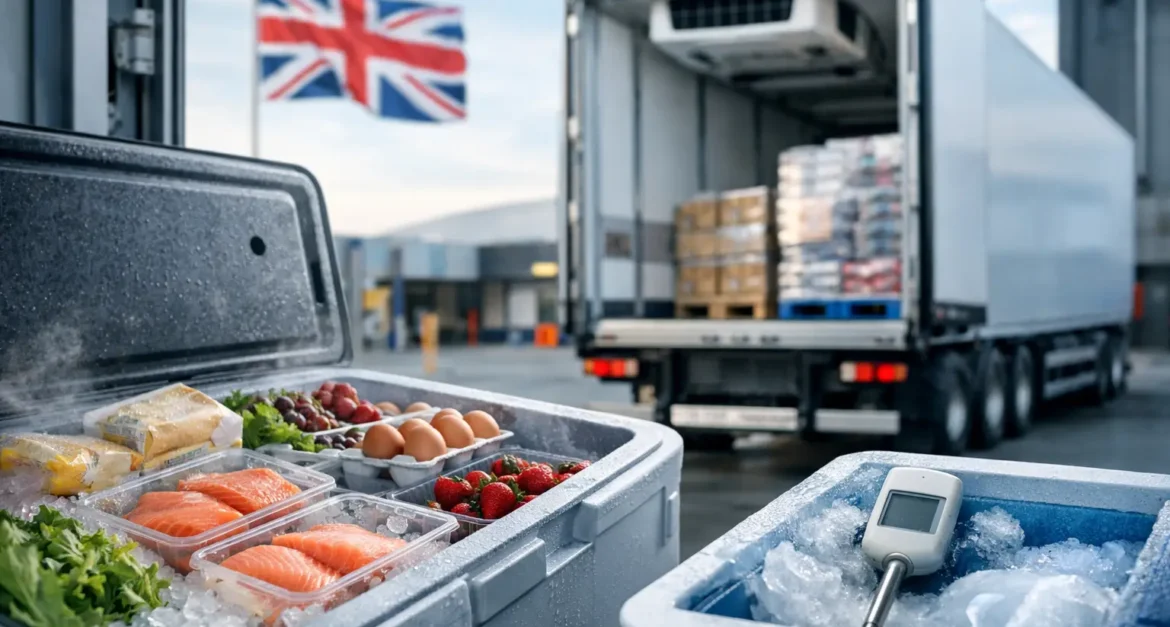
A refrigerated vehicle can arrive exactly on time and still create a food-safety risk if the product temperature, loading process or delivery records cannot stand up to scrutiny. UK chilled food regulations place the responsibility on food businesses to keep products safe throughout storage, handling and transport – not simply to operate a vehicle with refrigeration.
For wholesalers, manufacturers, caterers, retailers and food-service operators, that means treating every collection and delivery as part of the food-safety system. Temperature control, clean handling, traceability and clear procedures must work together. Where a product is compromised, the cost can extend beyond a rejected load to waste, disruption, enforcement action and damage to customer confidence.
What UK chilled food regulations require
The legal framework is built around food hygiene and food safety law, including retained EU food hygiene requirements and domestic food safety legislation. In practice, the central duty is straightforward: food must not be placed on the market if it is unsafe, and businesses must have effective procedures to prevent that outcome.
For transport operators and the businesses that appoint them, this normally means maintaining the temperature conditions specified for the food, preventing contamination and preserving a clear chain of custody. Food hygiene controls should be based on Hazard Analysis and Critical Control Point principles, often referred to as HACCP. The level of documentation should be proportionate to the operation, but a business must be able to show that it has identified risks and put meaningful controls in place.
The detailed requirement can depend on the food category, how it is packed, its shelf life and the manufacturer’s instructions. Foods of animal origin, ready-to-eat products and high-risk chilled ingredients can require tighter operational control than lower-risk items. Contractual standards imposed by a retailer or food manufacturer may also go beyond the legal baseline.
Temperature limits: the practical standard
A common misunderstanding is that every chilled product has the same legal temperature limit. It does not. The product label, product specification and risk assessment matter. Many chilled foods should be kept at 8°C or below, and this is a key legal benchmark for temperature-controlled foods in Great Britain. However, certain products have more specific requirements, while many food businesses set lower internal limits, such as 5°C, to create a safety margin.
The correct transport setpoint is therefore not a generic figure chosen on the day. It should be agreed before collection and reflect the manufacturer’s stated storage condition. A vehicle set to 5°C may be appropriate for one load, but not if product specifications require a tighter range. Equally, setting a vehicle unnecessarily cold can damage delicate produce or create avoidable energy use.
Temperature abuse is not limited to the journey. Product can warm during loading, cross-docking, waiting time at a distribution centre or a delayed delivery. A compliant cold chain controls these handovers, not just the temperature in transit.
The four-hour allowance is not a transport plan
Some businesses refer to the rule allowing certain chilled food to be kept above the usual temperature limit for a limited period. This is often understood as a four-hour allowance. It is a narrow operational provision, not permission to run routine deliveries without temperature control.
It applies only where food safety is not compromised and the business can justify the process. It should never be used to cover repeated delays, an underperforming refrigeration unit or poor loading discipline. For time-critical distribution, continuous temperature control remains the safer and more defensible approach.
Cooling and frozen products need separate controls
Cooked food that is being chilled must be cooled quickly enough to limit bacterial growth before it enters chilled storage or transport. The exact process should be validated for the product and operation. Relying on a refrigerated vehicle to cool down warm food is usually poor practice, as it can put the entire load at risk.
Frozen food requires its own specification, generally maintained at -18°C or colder for many commercial supply chains. It should not be managed as an extension of chilled distribution. Mixed loads require physical separation, correctly configured compartments and a loading plan that protects every temperature zone.
Transport controls that stand up to scrutiny
A refrigerated vehicle is only one part of compliance. The transport process needs defined controls from collection through to proof of delivery.
First, vehicles and equipment must be suitable for the load. Refrigerated bodies need sufficient capacity for the external conditions, route duration, door openings and product volume. Airflow is equally important. Poorly stacked pallets, blocked evaporators or product packed against air outlets can create hot spots even when the dashboard display appears correct.
Second, cleanliness must be managed with the same care as temperature. Vehicle interiors, shelving, pallets and handling equipment should be maintained in a condition that prevents contamination. Loads with incompatible odours, allergens, raw materials or non-food goods may require segregation. A clean vehicle is not simply presentable – it is a food-safety control.
Third, drivers need clear instructions. They should know the required temperature range, the collection and delivery contacts, what to check before loading, and what to do if a seal is broken, a product appears damaged or an alarm is raised. The right response to a deviation is not to guess. It is to protect the load, record the facts and escalate immediately to the responsible contact.
Monitoring, records and calibration
A temperature display in the cab does not prove the temperature experienced by the food. For high-integrity chilled distribution, businesses should use calibrated monitoring equipment and retain records that show conditions throughout the journey. Real-time monitoring adds another layer of control by allowing a team to identify and respond to a problem while the vehicle is still moving.
The frequency and type of monitoring should reflect the risk. A short, local delivery of sealed chilled goods may need a different control plan from a multi-drop route carrying ready-to-eat products over several hours. But where there is a complaint, audit or incident, records should make the journey clear: vehicle identity, temperature data, collection and delivery times, product details, exceptions and corrective action.
Calibration matters because unverified readings create false confidence. Thermometers, probes and data loggers should be checked and calibrated on a planned schedule, with evidence retained. If equipment is found to be inaccurate, the business should assess whether previous loads may have been affected rather than merely replacing the device.
Traceability and product information
Food traceability must enable a business to identify where food came from and where it went. In operational terms, transport documentation should connect the consignment to the supplier, customer, product description, batch or lot information where relevant, dates and delivery confirmation.
This is particularly important during a withdrawal or recall. If a food business cannot quickly identify affected deliveries, it may have to widen the response, increasing waste and commercial exposure. Electronic proof of delivery, GPS tracking and digital temperature records can provide the full visibility needed to investigate an issue quickly.
Food labels and product information must also remain legible and protected during transport. Where goods are redistributed into smaller units or handled across several parties, responsibility for preserving correct information must be clear. Temperature control does not replace allergen, date-code or packaging checks.
Managing a temperature deviation
No cold chain is risk-free. Traffic incidents, mechanical faults, power interruption and extended waiting times can occur. Compliance depends heavily on how the business responds.
A documented deviation procedure should define who is contacted, what data is captured, whether the load must be quarantined, and who has authority to make a disposition decision. The decision should be based on the actual product temperature, duration of exposure, product type, manufacturer guidance and evidence available – not on assumptions about whether the goods ‘feel cold’.
Drivers should not be placed in the position of deciding that compromised food is acceptable. Their role is to report quickly and preserve the evidence. The food business responsible for the product can then assess safety with the necessary technical information.
Choosing a chilled transport partner
When outsourcing distribution, the legal responsibility for food safety does not disappear. A logistics partner should be assessed as part of the supplier-approval process. Look beyond fleet capacity and price. Ask how temperatures are monitored, whether records are available per journey, how vehicles are cleaned, how multi-temperature loads are segregated, and how deviations are handled outside normal hours.
The right provider will be able to explain its controls clearly and operate them consistently. MT Logistics Group supports chilled, frozen and multi-temperature distribution with monitored vehicles, traceable delivery processes and responsive operational support – giving food businesses greater control over the journey their products take.
Chilled food compliance is won in the routine details: the correct setpoint confirmed before collection, doors opened for the shortest practical time, a temperature alert acted on immediately, and records ready when they are needed. Build those controls into every movement, and your cold chain becomes a source of assurance rather than a point of risk.