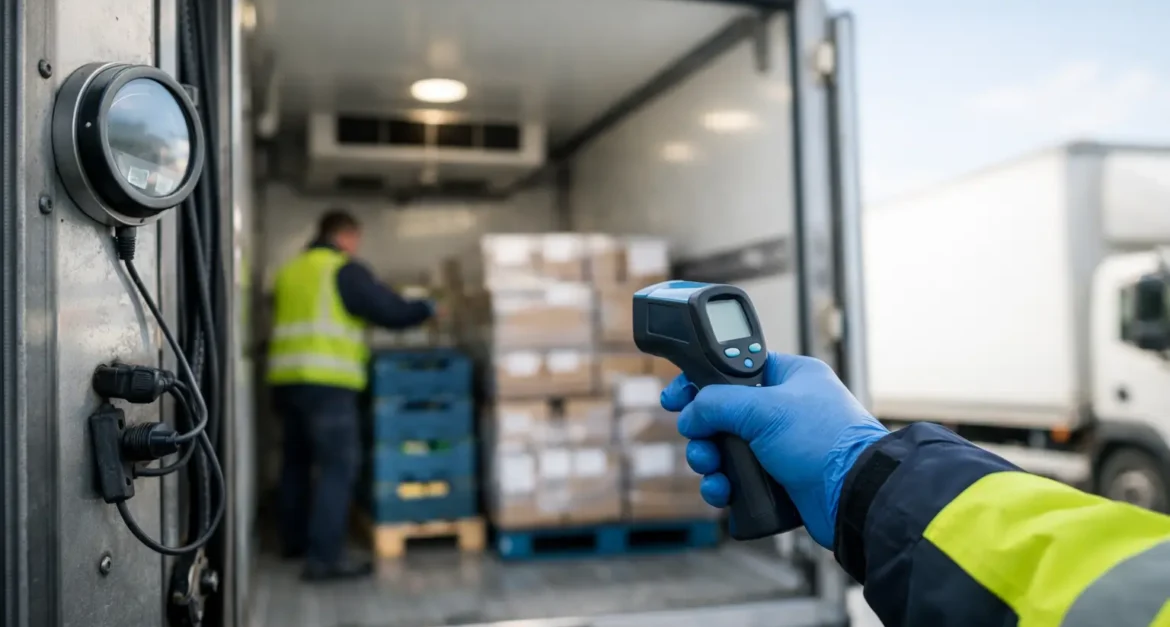
A temperature-controlled delivery can arrive on time, with an apparently healthy-looking load, and still leave a business exposed if there is no evidence of the conditions maintained in transit. Are temperature records mandatory? For many UK food, pharmaceutical and healthcare movements, the practical answer is yes: businesses must be able to demonstrate that products were handled and transported within the conditions required to protect safety, quality and compliance.
The legal and operational detail depends on the product, its risk profile, the agreed temperature range and the sector in which you operate. There is no single rule stating that every vehicle, for every journey, must produce the same type of temperature report. But relying on an unverified set point, a driver’s verbal confirmation or a thermometer reading at delivery is rarely enough where temperature control matters.
When are temperature records mandatory?
Temperature records are most clearly expected when they form part of the controls needed to keep goods safe and suitable for use. For food businesses, this usually sits within food hygiene procedures based on HACCP principles. If chilled, frozen or hot-held temperatures are critical to product safety, the business needs proportionate checks and records that show those controls were in place.
For pharmaceuticals, medical products and clinical materials, the expectation is often stricter. Good Distribution Practice requires supply-chain controls that protect products from unsuitable storage and transport conditions. Where a product has a defined temperature specification, records provide the evidence needed to show that specification was maintained, or to investigate any excursion properly.
The same principle applies to specialist products such as temperature-sensitive chemicals, cosmetics, biological samples and high-value ingredients. A contract, customer quality agreement, product specification or insurer may require records even where a specific sector regulation does not prescribe a particular report format.
The key question is not simply whether a vehicle is refrigerated. It is whether you can demonstrate that the product experienced the required environment throughout collection, loading, transit, waiting time and delivery.
Temperature records for food transport
Food transport rules focus on maintaining appropriate conditions rather than creating paperwork for its own sake. A chilled product may need to remain at a defined maximum temperature; frozen food needs protection against thawing; and ambient goods may still have upper or lower limits where heat, frost or humidity could compromise quality.
A business should record temperatures where doing so is necessary to control a food safety risk. For a local, low-risk movement, manual checks at defined points may be sufficient if they are meaningful and consistently completed. For a long-distance, multi-drop or high-risk delivery, continuous digital monitoring is usually the stronger control. It creates a time-stamped record rather than a snapshot.
This distinction matters. A reading of 3°C at the consignee’s door does not prove the load remained within range during a two-hour delay at a distribution centre. Nor does a refrigerated vehicle‘s display prove the temperature inside the load space, or around the product, stayed stable after repeated door openings.
For frozen food, records should also support checks for temperature fluctuations. Short, controlled deviations may be assessed differently from a sustained rise, depending on the product specification and food safety plan. The decision should be evidence-led, not based on appearance or assumption.
What a useful food temperature record contains
A record should allow an operations or quality team to reconstruct the journey quickly. It normally identifies the vehicle or device, consignment, collection and delivery points, journey dates and times, the required temperature range, recorded temperatures and any action taken when a limit was approached or exceeded.
Where digital monitoring is used, the record should show a clear audit trail. That includes the data interval, sensor location where relevant, alerts raised, acknowledgement of alerts and the outcome of any investigation. Manual records need the same discipline: legible readings, the person who completed the check and no unexplained gaps.
Pharmaceutical transport needs a higher standard of evidence
In pharmaceutical and medical cold-chain delivery, temperature data is part of product release and quality assurance, not merely a transport administration task. The receiver may need to review the journey record before accepting stock into saleable inventory. A missing report can delay supply even if the delivery arrived within the agreed slot.
The correct control depends on the product and route. Some movements need validated packaging with a data logger travelling with the consignment. Others need a temperature-mapped vehicle, calibrated sensors, continuous monitoring and alarm escalation. Multi-temperature routes require separate evidence for each controlled compartment or product zone.
There is a trade-off between the level of monitoring and the risk involved. A short, local movement of an established chilled product does not necessarily require the same controls as an urgent consignment of investigational medicinal product. However, the transport plan must be defensible. It should be based on product requirements, expected transit time, external conditions, delivery risk and the consequence of failure.
A live screen is not the same as an auditable record
Real-time temperature monitoring gives operations teams the chance to act before a small issue becomes a rejected load. GPS visibility can confirm where a vehicle is when an alert occurs, helping the transport team decide whether to adjust the unit, reroute the vehicle, protect the load or notify the customer.
That live visibility is valuable, but it is only one part of compliance. The record must also be retained in a form that can be retrieved after the journey. A customer, auditor or quality team may ask for evidence days, weeks or months later. If the data is not complete, associated with the correct consignment and protected from unauthorised changes, it may not provide the assurance required.
A dependable record system therefore needs more than a vehicle display. It needs calibrated equipment, clear responsibilities, secure data retention and a process for reviewing exceptions.
How long should temperature records be kept?
There is no single retention period for every temperature-controlled delivery. The appropriate period may be set by food safety procedures, pharmaceutical quality systems, customer contracts, traceability requirements or the shelf life of the product. Some businesses also need records available for complaint investigations, recalls or regulatory inspections long after delivery.
Set a documented retention period that reflects the product and your contractual obligations. The important point is consistency. Records should be accessible, readable and linked to the relevant consignment for the full period you have committed to retain them.
What to do when a temperature deviation occurs
A deviation is not automatically a product failure, but it must never be ignored. The first priority is to protect the goods. Confirm the actual temperature, the duration of the excursion, the affected area of the load and whether the issue is ongoing. If appropriate, segregate the stock and stop it entering normal distribution.
Next, preserve the evidence. Download the temperature data, record relevant vehicle and route information, and document any operational event such as a door being left open, refrigeration unit fault, traffic delay or delivery-site hold-up. The product owner or responsible quality team should then assess the excursion against the product’s approved limits and stability information.
The final decision may be to release, rework, return, destroy or place stock in quarantine. Transport teams should not make a quality disposition without the agreed authority, particularly for pharmaceutical goods. Their role is to provide accurate information quickly and take immediate steps to prevent further exposure.
Building a record process that stands up to scrutiny
Temperature records work best when they are designed into the transport operation from the outset. Start with a written agreement on the required range, tolerances, sensor placement, monitoring frequency, alert thresholds, report format and escalation contacts. This avoids a common failure: discovering at delivery that the customer expected continuous data while the carrier recorded only departure and arrival readings.
Equipment also needs control. Sensors and probes should be suitable for the operating range, checked and calibrated on a documented schedule. Vehicles should be maintained, and temperature-controlled compartments should be assessed for their ability to hold the required range under real operating conditions, including door openings and multi-drop work.
Finally, train drivers and control-room teams to respond to alarms rather than merely acknowledge them. A temperature report is valuable because it drives timely action. The strongest cold chain is one where an emerging problem is identified, contained and evidenced before it compromises the load.
For businesses moving goods where quality cannot be recovered once it is lost, temperature data is more than a compliance document. It is the proof that every delivery received the control, traceability and care your customers expect.