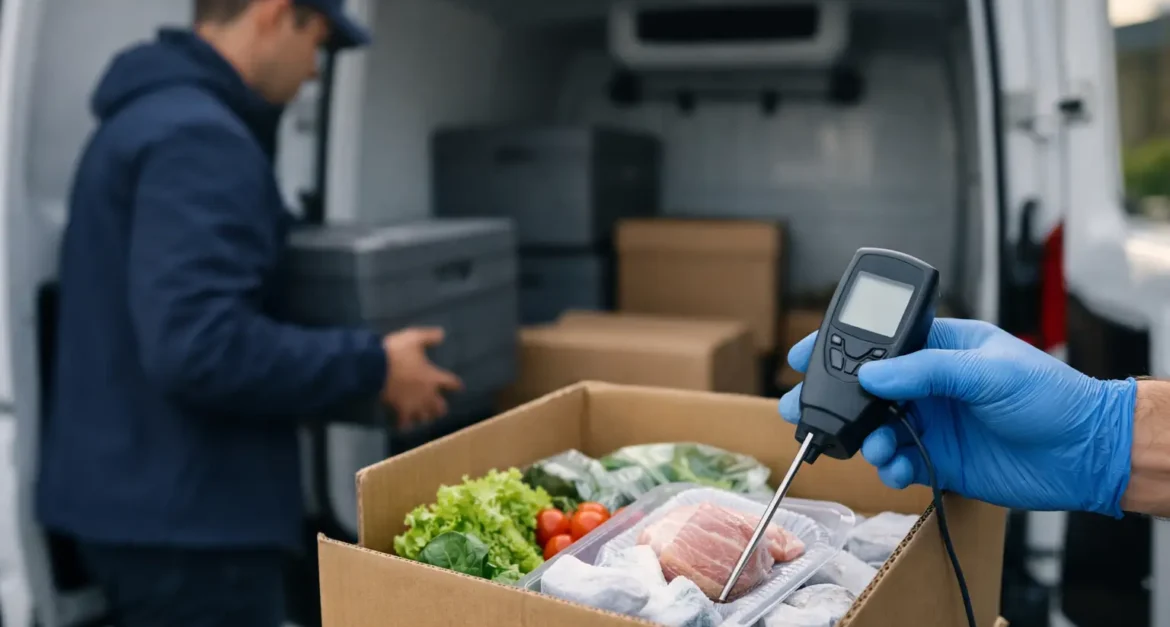
A chilled consignment can arrive on time, look correct and still be unsuitable for use if its temperature history cannot be proven. For operations teams asking, “how are delivery temperatures verified?”, the answer is not a single reading at the destination. Reliable verification is a controlled process that starts before collection, continues throughout transit and ends with clear, retrievable evidence at handover.
For food, pharmaceutical, healthcare and other temperature-sensitive goods, that evidence protects more than the product. It supports quality procedures, customer requirements, audit readiness and informed decisions if an exception occurs.
How delivery temperatures are verified from collection to handover
Delivery temperature verification begins by agreeing the required transport condition. This may be chilled, frozen, controlled ambient or a separate set point for each compartment of a multi-temperature vehicle. The required range should be clear on the transport instruction, along with any product-specific handling requirements, delivery window and escalation contacts.
Before loading, the vehicle is pre-cooled or pre-heated as required and its refrigeration unit is checked for correct operation. The loading area, doors, seals and compartment configuration also matter. A refrigerated vehicle cannot protect a consignment if warm stock is loaded into an unprepared space, or if goods for different temperature bands are placed in the wrong compartment.
The transport team then records the operating temperature at collection and confirms that the consignment has been loaded under appropriate conditions. Depending on the service and risk profile, this may include a vehicle sensor reading, a portable probe check, a consignment-specific data logger or a combination of these controls.
During the journey, digital monitoring equipment records temperature at defined intervals. Modern refrigerated vehicles can transmit readings in real time alongside GPS location, allowing the operator to see whether the unit is holding its set point and whether the vehicle is progressing to plan. At delivery, the final recorded condition is checked against the agreed range and retained with the delivery record.
This creates a temperature trail, rather than relying on a driver’s recollection or an isolated end-point reading.
Continuous monitoring gives the clearest picture
A single temperature check tells you what was happening at one moment. Continuous monitoring shows what happened across the whole journey. That distinction is critical where goods are vulnerable to short excursions caused by door openings, traffic delays, refrigeration faults or incorrect loading practices.
Digital sensors installed in the load space record air temperature, often at frequent intervals. The readings are stored in a data log and, where telematics are in use, can be viewed remotely by the transport operator. GPS data adds useful context: a temperature change can be assessed against the vehicle’s location, route progress and stop duration.
For high-value or tightly regulated consignments, a separate calibrated data logger may travel with the goods. This gives an independent record for that consignment and can be particularly useful for pharmaceutical deliveries, clinical materials or products moving through several handling points.
The right method depends on the product and the agreement with the customer. Vehicle monitoring is often suitable for standard chilled or frozen distribution when the load space is controlled correctly. A dedicated in-load logger may be necessary when a customer needs consignment-level evidence, specific reporting intervals or a more detailed audit trail.
Air temperature and product temperature are not identical
One practical point is often missed: the vehicle’s air temperature is not always the same as the temperature at the centre of a product. Air responds quickly when doors open or warm air enters the compartment. A dense frozen pallet, by contrast, changes temperature more slowly.
That does not make air-temperature monitoring less valuable. It is the primary way to demonstrate that the vehicle environment remained controlled. But where product-core temperature is required, checks must be carried out using a suitable calibrated probe and a safe, agreed sampling method. The result should be recorded without damaging packaging, contaminating product or delaying the delivery unnecessarily.
Calibration makes temperature records credible
A precise-looking reading is only useful if the measuring equipment is accurate. Temperature sensors, probes and data loggers should therefore be calibrated at planned intervals against recognised standards or traceable reference equipment.
Calibration confirms whether an instrument reads within its permitted tolerance. If it does not, the device must be adjusted, replaced or removed from service. Calibration certificates and service records should be available as part of a supplier’s quality documentation, particularly where the delivery supports regulated or audit-sensitive supply chains.
It is also good practice to protect equipment from avoidable error. Sensors need sensible placement away from direct airflow, evaporator outlets and door openings where possible. Portable probes must be cleaned, stored correctly and checked before use. A well-calibrated probe used carelessly can still produce an unreliable result.
Vehicle checks protect the cold chain before departure
Temperature verification is not only about data. It also depends on the physical condition of the vehicle and the way the load is handled. Pre-departure checks should confirm that the refrigeration unit is operating, the selected set point is correct and the vehicle can maintain the required condition before it leaves site.
The team should also look for issues that could compromise control, such as damaged door seals, obstructed airflow, poorly secured pallets or a load stacked too close to refrigeration outlets. In a multi-temperature operation, each compartment must be clearly separated and set independently to avoid cross-temperature exposure.
Loading discipline matters just as much. Goods should be ready to load, doors should not be held open longer than necessary, and delivery routes should be planned to limit unnecessary dwell time. For multidrop distribution, the order of drops and compartment access can affect temperature stability. The most efficient route is not always the route that best protects the product.
What happens when there is a temperature deviation?
No responsible cold-chain operator should treat every alarm as an automatic product failure. Equally, no deviation should be ignored. The correct response depends on the agreed tolerance, the duration of the excursion, the product type and the manufacturer’s or customer’s quality procedure.
When monitoring identifies an out-of-range reading, the priority is to act quickly. The driver or control team checks the refrigeration unit, door status, set point and load condition. If safe and appropriate, the vehicle may be redirected, the affected compartment isolated or a replacement vehicle arranged. Real-time visibility makes this response faster because the issue can be investigated while the consignment is still in transit.
The event should be documented with the time, temperature, location, duration, corrective action and outcome. The customer can then assess the goods using complete information rather than assumptions. For pharmaceutical and medical products, release or rejection decisions may need to follow the product owner’s documented quality process. For food, the decision may be linked to the product specification, shelf-life controls and food safety procedures.
The key principle is simple: verification is valuable because it enables a controlled decision when conditions do not go exactly to plan.
Proof of delivery should include more than a signature
A signature confirms receipt. It does not, by itself, prove that a temperature-sensitive consignment arrived under compliant conditions. Strong proof of delivery combines recipient confirmation with the relevant transport evidence.
This may include the delivery time, vehicle or logger reading at arrival, digital temperature record, condition notes and any reported exception. If the receiving team carries out its own intake check, any difference between its reading and the vehicle record should be investigated in context. Probe location, packaging, time since unloading and local receiving conditions can all affect the result.
Records should be retained in a form that is easy to retrieve. When a customer asks for a temperature report weeks or months later, the operator should be able to provide a clear record tied to the consignment, route and delivery event. That level of traceability supports complaint handling, supplier reviews and compliance audits without creating unnecessary disruption.
Questions to ask a temperature-controlled transport provider
Before appointing a carrier, ask how readings are captured, how frequently they are logged and whether live alerts are available. Establish whether equipment is calibrated, what evidence is supplied after delivery and how temperature exceptions are escalated.
It is also worth confirming how the provider manages pre-cooling, mixed-temperature loads, urgent deliveries and lengthy waiting times at site. A service designed for frozen food distribution may need different controls from a pharmacy replenishment run or a same-day medical consignment. The right solution is based on your product risk, not a generic temperature promise.
MT Logistics Group uses refrigerated vehicles, real-time digital temperature monitoring and full journey traceability to give customers clear control over temperature-sensitive deliveries. When the transport requirement is defined properly at the start, every collection, journey and handover can be managed with greater certainty – and your receiving team has the evidence needed to accept goods with confidence.