A blood tube, biopsy, swab or clinical-trial specimen can lose its value long before it reaches a laboratory. A missed collection slot, an incorrect temperature range or incomplete chain-of-custody record may affect patient care, delay a study or create a compliance issue. Knowing how to ship medical samples means controlling the entire journey, not simply placing a package with a courier.
For laboratories, hospitals, pharmacies, biotech businesses and medical distributors, the right process begins with the sample itself. Its classification, stability profile, packaging requirements and delivery deadline determine the vehicle, packaging system and handling controls required.
How to Ship Medical Samples Safely
The first rule is simple: establish exactly what is being moved before arranging collection. Medical samples are not one uniform category. They may include diagnostic specimens, infectious substances, pathology material, human tissue, temperature-sensitive medicines or clinical-trial samples. Each brings different risks and may be subject to different transport requirements.
Confirm the sample’s biological classification with the competent person in your organisation. For example, many diagnostic or clinical specimens may be shipped as Biological Substance, Category B, UN3373, where applicable. Infectious substances capable of causing serious disease may fall into Category A and require a more stringent dangerous goods process. Dry ice is also regulated as UN1845 and creates its own packaging, ventilation and documentation requirements.
Do not assume that a familiar sample can be sent under the same conditions every time. The origin, destination, contents, transport mode and packaging configuration can all change the requirement. For cross-border movements, the rules and paperwork may differ again. Where there is uncertainty, seek advice from a trained dangerous goods professional before the consignment is released.
Set the Required Temperature From Stability Data
Temperature control should be based on documented sample stability, laboratory instructions or the manufacturer’s specification. “Keep cool” is not a sufficiently precise instruction for a time-critical medical movement.
Some samples may need controlled ambient conditions, while others need chilled transport, frozen transport or deep-frozen conditions. The acceptable range, maximum transit time and permitted excursion must be confirmed in advance. A specimen that tolerates 2°C to 8°C for 24 hours requires a different solution from one that must remain frozen at -20°C or below.
This is where trade-offs matter. Passive packaging can be suitable for shorter, validated journeys with a predictable handover. For longer routes, urgent consignments or consignments with little tolerance for temperature variation, an actively temperature-controlled vehicle may provide greater assurance. The correct choice depends on risk, not just cost.
Build a Validated Packaging System
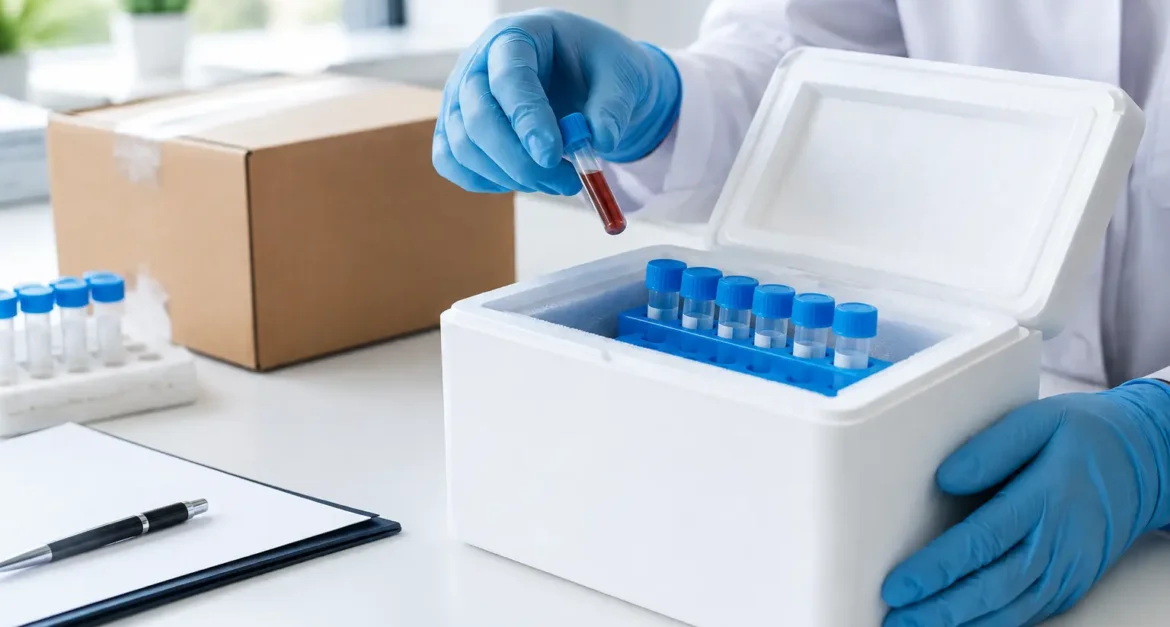
Medical samples should be protected from leakage, breakage, temperature loss and unauthorised interference. For many biological substances, this means using a triple-packaging system: a leakproof primary receptacle, a leakproof secondary package and a rigid outer package.
Absorbent material should be placed between primary and secondary packaging where liquid samples are being carried. It must be capable of absorbing the full contents if the primary receptacle fails. Multiple primary receptacles should be individually wrapped or separated to prevent contact and breakage.
The outer packaging must protect the contents through normal transport handling. It should carry the correct marks and labels for the classification, alongside the sender and recipient details. If dry ice is used, the packaging must allow carbon dioxide gas to vent safely. Never seal dry ice inside an airtight container.
Temperature-control materials must be prepared correctly. Refrigerant packs need to be conditioned to the required temperature, while frozen samples need sufficient dry ice or other validated cooling media to cover the full journey and a realistic contingency period. Over-cooling is also a risk. A chilled sample placed directly against frozen gel packs may freeze, even when freezing would compromise the result.
Use Monitoring That Proves Control
A temperature-controlled journey should be evidenced, not assumed. Place a calibrated data logger in a representative position within the package or load, following the packaging validation plan. The logger should record at intervals that are meaningful for the sample’s risk profile.
Real-time monitoring adds further control for higher-risk consignments. It allows the transport team to see location and temperature during the journey, respond quickly to delays and provide a clear record at delivery. For a same-day route between a hospital and laboratory, this visibility can be the difference between resolving an issue early and discovering a failed sample after arrival.
Keep calibration records, temperature data and any excursion assessment with the shipment documentation. A logger is only useful when someone is responsible for reviewing the information and escalating deviations.
Plan Collection, Transit and Delivery Around the Sample
The transport plan should be designed backwards from the laboratory’s acceptance window. Confirm the receiving site’s opening hours, named contact, delivery entrance, accessioning cut-off and any requirement for advance notification. A package arriving at the correct address after the laboratory has closed is not a successful delivery.
At collection, verify the number of packages, packaging condition, consignment reference, collection time and declared temperature requirement. The driver should know whether the consignment needs controlled ambient, chilled, frozen or multi-temperature transport before loading takes place.
For urgent or high-value samples, a dedicated vehicle is often preferable to a multi-drop route. It reduces handovers, handling points and transit uncertainty. Multi-drop distribution can work for stable, lower-risk samples where the route, time window and temperature capability have been assessed in advance. The decision should reflect the potential consequence of delay or temperature deviation.
A specialist refrigerated courier can maintain the required set point from collection through to delivery, rather than relying solely on passive packaging in an uncontrolled vehicle. For mixed loads, compartments or vehicles with independently controlled temperature zones may be required to prevent incompatible products travelling together.
Maintain an Unbroken Chain of Custody
Traceability protects the sample, the organisation and the recipient. Every handover should be recorded, from the person releasing the package to the driver collecting it and the individual accepting delivery.
Your chain-of-custody record should capture the consignment reference, date and time of collection, collection location, recipient, packaging condition, temperature requirement, handover names and proof of delivery. For clinical trials or sensitive patient material, your protocol may require additional controls such as tamper-evident seals, unique sample identifiers or restricted-access handling.
Instructions should be clear enough to act on under pressure. If a vehicle breaks down, a delivery point is inaccessible or a temperature alert occurs, the driver and transport control team need a defined escalation route. This should identify who can approve a change of destination, replacement packaging, onward movement or sample quarantine.
Check Your Carrier’s Medical Capability
Not every same-day courier is equipped to transport medical samples responsibly. Ask practical questions before booking: can they provide the required temperature range, real-time tracking, temperature records, trained personnel and documented proof of delivery? Can they support urgent collection outside normal hours? Do they understand the distinction between a routine parcel and a regulated biological consignment?
The provider should also be able to explain how vehicles are cleaned, maintained and monitored, how exceptions are managed, and what happens if a delivery cannot be completed. Confidence should come from defined procedures and visible controls, not broad assurances.
MT Logistics Group supports time-critical medical and pharmaceutical movements with temperature-controlled vehicles, GPS tracking and digital temperature monitoring, giving operations teams full visibility from collection to delivery.
A Practical Pre-Dispatch Check
Before release, confirm that the sample classification is correct, the packaging is appropriate, labels and documentation are complete, and the required temperature range is clear. Check that cooling materials have been conditioned, the data logger is activated and the recipient is ready to receive the consignment.
Finally, ensure the collection time leaves enough margin for loading, traffic disruption, site access and laboratory cut-off. In medical transport, a controlled plan with contingency is more valuable than a fast plan built on assumptions.
When a sample carries clinical, commercial or research value, treat its transport as part of the testing process. The right preparation, specialist handling and documented control help it arrive ready for the decision it was collected to support.