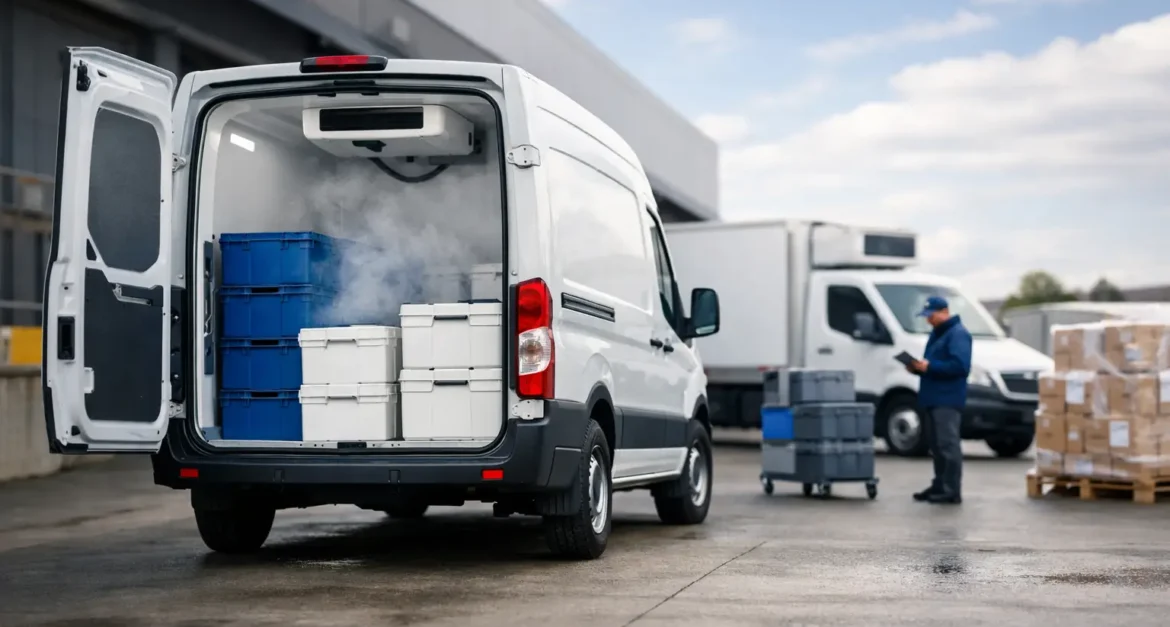
A delivery window can be missed and recovered. A chilled load that drifts out of range often cannot. That is why temperature controlled delivery vans matter far beyond transport alone. For food, pharmaceuticals, healthcare products and other sensitive goods, the vehicle is part of the quality system, not just the journey.
Businesses that move temperature-sensitive products are under pressure from every direction. Retailers expect precise booking slots. regulators expect documented compliance. Customers expect goods to arrive in saleable, safe condition. When the margin for error is narrow, the choice of vehicle and operator has a direct effect on product integrity, waste, customer trust and operational continuity.
What temperature controlled delivery vans actually do
Temperature controlled delivery vans are designed to maintain a specified internal environment while goods are in transit. That may mean chilled distribution for fresh produce and dairy, frozen transport for ice cream and prepared meals, or tightly controlled ranges for pharmaceutical and medical products. In some cases, it also means carrying ambient goods alongside chilled or frozen stock in separate compartments.
The key point is control. A standard van with insulated packaging may be suitable for some short journeys, but it is not the same as an actively managed cold-chain vehicle. Specialist vans use refrigeration equipment, insulated bodies and monitoring systems to keep temperatures stable from collection to delivery. That stability becomes especially important when vehicles are making multiple drops, waiting at delivery points or operating during warmer weather.
For many businesses, the risk is not dramatic equipment failure. It is gradual exposure – doors opening too often, poor load placement, inconsistent pre-cooling, or lack of temperature records when an audit or customer query lands. A properly specified vehicle helps prevent those smaller failures that become expensive problems later.
Why the right van specification matters
Not every chilled van is suitable for every load. The right specification depends on the product, route profile, delivery frequency and compliance requirement.
If you are moving fresh food across a local area with a small number of drops, a compact refrigerated van may be enough. If you are distributing mixed loads to hospitality sites, convenience stores or healthcare locations, compartmentalised vehicles may be needed to separate frozen, chilled and ambient stock. If you are handling medical products with strict handling requirements, validation, traceability and calibrated monitoring become far more important than payload alone.
This is where many procurement decisions go wrong. Businesses often focus on capacity and cost per mile first, then treat temperature control as a basic feature. In practice, vehicle selection should start with the acceptable temperature range, journey duration, loading pattern and consequence of deviation. A van that is technically refrigerated but operationally unsuited to the route can still put the load at risk.
Single-temperature vs multi-temperature vans
Single-temperature vans are often the most efficient option when every item in the load shares the same thermal requirement. They are simpler to manage, can offer more usable space and are often well suited to dedicated route work.
Multi-temperature vans bring greater flexibility. They allow operators to carry frozen, chilled and ambient goods in one journey, which can reduce vehicle movements and support consolidated distribution. The trade-off is complexity. Partitioning, airflow management and loading discipline all matter more. If the operation is not managed properly, flexibility can come at the expense of consistency.
Compliance is not optional
In temperature-sensitive logistics, compliance is built into daily operations. Food businesses must protect product safety under HACCP principles and demonstrate that goods have been stored and transported appropriately. Pharmaceutical and healthcare supply chains face even tighter scrutiny, with expectations around validated processes, documented temperature records and full traceability.
Temperature controlled delivery vans support compliance by creating a controlled transport environment and generating evidence of that control. Real-time monitoring, data logging and route visibility are no longer nice extras. They are part of the proof that the delivery was handled correctly.
This matters when something goes wrong, but it also matters when nothing goes wrong. Audits, customer onboarding, supplier reviews and internal quality checks all rely on accurate records. If a buyer asks whether a product remained within range throughout transit, the right operator should be able to answer clearly and quickly.
The operational features that make a real difference
On paper, many refrigerated vehicles can look similar. In day-to-day operations, the details separate dependable service from avoidable risk.
Insulation quality affects how well the vehicle resists external heat gain and how hard the refrigeration unit needs to work. Refrigeration performance determines whether the system can hold temperature during summer conditions, repeated door openings and busy multidrop schedules. Digital monitoring provides continuous visibility rather than relying on manual checks at departure and arrival.
GPS tracking also plays a practical role. It helps operations teams manage ETAs, respond to delays and maintain communication with sites expecting time-critical deliveries. For businesses supplying retailers, restaurants, hospitals or pharmacies, that visibility supports better planning at both ends of the journey.
Load configuration matters too. Poorly packed stock can block airflow and create hot spots inside the van, even when the refrigeration unit is working correctly. Shelving, partitions and disciplined loading procedures are often overlooked, but they have a direct impact on temperature consistency.
When temperature controlled delivery vans are the right choice
For many businesses, vans are the right fit because they combine control with flexibility. They are well suited to urban deliveries, regional routes, urgent replenishment work and time-critical consignments where access, speed and precision matter.
A rigid refrigerated lorry may be better for larger consolidated loads moving to distribution centres. A temperature-controlled van is often the stronger option for tighter delivery windows, smaller consignments, city-centre access and direct-to-site service. That includes same-day movements, multidrop schedules and dedicated vehicle requirements where the load cannot be delayed by hub-based handling.
This is particularly relevant for sectors such as foodservice and healthcare. A restaurant chain waiting on chilled stock before service, or a medical customer expecting a defined delivery slot, needs more than a generic courier model. They need a vehicle and driver setup built around the requirements of the goods.
Questions to ask before choosing a provider
If you are reviewing transport support, focus on how the service performs under pressure, not just how it is priced.
Ask what temperature ranges the vans are designed to maintain and whether there is live temperature monitoring throughout the journey. Check how data is recorded and how quickly records can be provided if needed. Find out whether the fleet can support single-temperature and multi-temperature movements, and whether the provider is experienced in your sector rather than temperature-controlled transport in general.
It is also worth asking how exceptions are handled. Delays, road closures and rejected deliveries happen. What matters is whether the operator has a clear escalation process, route visibility and contingency planning to protect the load when plans change.
A dependable provider should speak confidently about pre-cooling, loading procedures, equipment checks, delivery windows and proof of delivery. If those answers are vague, the service may be too.
The cost question and the bigger commercial picture
Temperature controlled delivery vans cost more to operate than standard vehicles. There is specialist equipment to maintain, tighter processes to follow and higher expectations around compliance and reporting. On a simple rate comparison, standard transport can look cheaper.
But transport cost should be measured against total risk. One spoiled load, one failed audit trail or one missed retail delivery can outweigh a long run of small savings. The true value of specialist cold-chain transport is in protecting goods, avoiding waste, maintaining customer confidence and keeping operations moving.
For growing businesses, the right transport setup can also improve scalability. A provider that offers dedicated vehicles, urgent same-day response, multidrop capability and nationwide coverage can support seasonal peaks, new contracts and changing delivery patterns without forcing you to rebuild your logistics model each time demand shifts.
That is where specialist operators such as MT Logistics Group stand apart. The vehicle is only one part of the service. The real advantage comes from combining the right fleet with monitoring, traceability and a team that understands what is at stake when temperature-sensitive goods are on the move.
Temperature control is only as strong as the operation behind it
A refrigerated van on its own does not guarantee a protected cold chain. Results depend on planning, equipment, driver discipline, monitoring and response. When those elements work together, temperature controlled delivery vans give businesses what they actually need – control, visibility and confidence that the goods arriving on site are the same quality as the goods that left.
If your products cannot afford temperature drift, vague tracking or improvised handling, the transport decision should be treated as an operational safeguard, not a basic buying exercise. The right setup protects more than the load. It protects the promise you make to every customer waiting for it.