A frozen delivery can arrive on time and still fail. If the product has been exposed to an uncontrolled temperature, left waiting at a loading bay, or transferred without a clear record, the risk has already entered the supply chain. Effective frozen food distribution is designed to prevent that risk, protecting product quality from collection through to the final handover.
For food manufacturers, wholesalers, retailers, hospitality operators and meal-prep businesses, the standard is not simply a cold vehicle. It is controlled transport, disciplined handling and evidence that the agreed temperature conditions were maintained throughout the journey.
What frozen food distribution needs to protect
Most frozen products are held and transported at -18°C or below, although the correct set point, permitted tolerance and handling instructions must always follow the product specification. A product may be safe at the point it is loaded, but cold-chain control can be lost through small operational failures: a door left open too long, an unplanned route delay, a vehicle that has not been pre-cooled, or a delivery site that cannot receive the consignment promptly.
The consequences are commercial as well as technical. Temperature abuse can reduce shelf life, affect texture and quality, increase waste, trigger rejected loads and put customer contracts at risk. Where evidence is incomplete, even a product that appears acceptable may be difficult to release with confidence.
A dependable distribution operation therefore protects four things at once: temperature, time, traceability and product condition. These controls need to work together. GPS location data is useful, for example, but it does not prove that the load remained within its required temperature range. Equally, a temperature record is only meaningful when it can be linked to the correct vehicle, journey and delivery.
The controls behind reliable frozen food distribution
Start with the right vehicle and set point
Vehicle selection should reflect the product, load profile and route, not just the number of pallets. A frozen load requires a suitably specified refrigerated vehicle that has been pre-cooled before loading and set to maintain the agreed conditions. For mixed consignments, a multi-temperature vehicle may be necessary to separate frozen goods from chilled or ambient stock.
Capacity also matters. Overloading a vehicle, blocking airflow or loading warm product into an already challenging route creates avoidable pressure on the refrigeration system. A specialist provider will assess collection and delivery times, pallet configuration, access restrictions, delivery windows and the likely duration of door openings before dispatch.
Maintain control at every handover
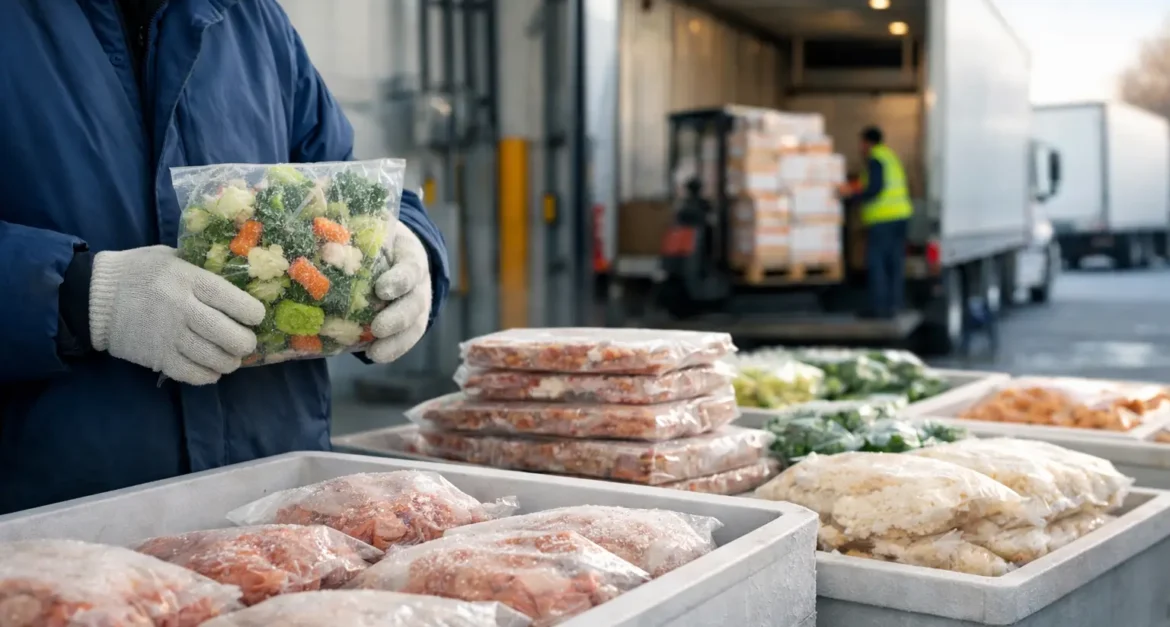
The highest-risk moments are often not while the vehicle is moving. They are during loading, unloading and waiting periods. Product should move from frozen storage into a pre-conditioned vehicle quickly, with doors opened only when necessary. At delivery, the receiving site must be ready to accept the goods without an extended wait on the vehicle.
This is especially relevant for multidrop distribution. Each stop introduces another door opening, another handling process and another opportunity for delay. Route planning should group drops intelligently, protect the most time-sensitive delivery windows and allow realistic time for each site. The cheapest route on paper is not always the route with the lowest temperature risk.
Monitor, record and act on exceptions
Digital temperature monitoring provides visibility throughout the journey. It allows transport teams to verify operating conditions, identify a potential issue early and create a clear temperature record for the customer. Combined with GPS tracking and proof of delivery, it gives operations managers a practical audit trail rather than an assumption that the load was handled correctly.
Monitoring alone is not enough. The value comes from an agreed response when an alert or deviation occurs. The transport team needs to know who to contact, what product information is required, whether the vehicle should continue, and how the incident will be recorded. Clear escalation protects decision-making when time is limited.
Planning around the realities of the UK network
Frozen distribution across the UK is rarely a simple depot-to-depot movement. Urban delivery restrictions, supermarket booking slots, hospitality service times, congestion, weather disruption and limited unloading access all affect the plan. A vehicle may only have a narrow window to serve a city-centre site, while a regional distribution centre may reject a delivery that misses its booked slot.
The right approach depends on the operating model. A regular retail network may benefit from planned multidrop routes and fixed delivery days. A manufacturer with fluctuating production volumes may need dedicated day-rate capacity that can respond to demand without compromising control. A restaurant group facing an urgent stock shortfall may require a same-day refrigerated courier rather than waiting for the next scheduled run.
These are different services, but the objective is consistent: keep frozen goods within specification and deliver them when the customer needs them. Planning must be flexible enough to respond to disruption without becoming improvised.
Questions to ask a frozen distribution partner
Choosing a provider based only on transport price can leave critical gaps in service. Before placing a load, procurement and logistics teams should establish whether the provider can demonstrate control in the areas that matter to their operation:
- What temperature range can the vehicle maintain, and how is that temperature monitored?
- Are temperature records available for the full journey and linked to the delivery?
- Can the provider support frozen-only, chilled, ambient and multi-temperature loads where required?
- How are delays, alarms, rejected deliveries and other exceptions escalated and documented?
- Does the fleet, driver training and route planning capability match the required delivery profile?
The answers should be specific. “Refrigerated transport” is a broad description, and not every refrigerated service is suitable for a frozen product with strict delivery windows, multiple drops or customer audit requirements.
The trade-off between speed, consolidation and control
There is no single best distribution model for every frozen food business. Consolidated transport can reduce cost and improve vehicle utilisation, particularly for predictable volumes and compatible routes. However, shared loads can mean less control over timing, additional stops and a greater reliance on the wider route operating exactly as planned.
Dedicated transport gives the shipper more direct control over collection time, route, security and delivery priority. It is often the stronger choice for high-value loads, urgent replenishment, sensitive product lines or customers with narrow booking windows. The trade-off is cost, especially when vehicle capacity is not fully used.
A practical solution may combine both. Planned retail replenishment can move through a structured multidrop operation, while production overruns, launch stock or urgent wholesale orders are handled through dedicated temperature-controlled vehicles. The key is to choose the service around the product risk and operational requirement, rather than applying one model to every load.
Why traceability protects more than the product
When a customer asks whether a frozen consignment was maintained correctly, a fast and evidence-based answer protects relationships. Full journey visibility helps teams resolve queries, investigate claims and make informed decisions if an exception occurs. It also supports internal quality processes and demonstrates that transport has been treated as part of food safety, not as a separate final step.
Traceability is particularly valuable when multiple parties are involved. A manufacturer, wholesaler, carrier and receiving site may all need the same facts: collection time, delivery time, location history, temperature information and proof of receipt. Clear records reduce uncertainty and prevent a minor issue becoming a prolonged dispute.
MT Logistics Group supports frozen food transport with temperature-controlled vehicles, real-time monitoring, GPS tracking and traceable delivery processes across the UK. The focus is straightforward: maintain control from collection to final handover, so product arrives in the condition your customer expects.
When frozen stock is central to your operation, transport should not be the point where certainty ends. Build the distribution plan around the product specification, the delivery reality and the evidence your business needs – then give your customers every reason to receive with confidence.