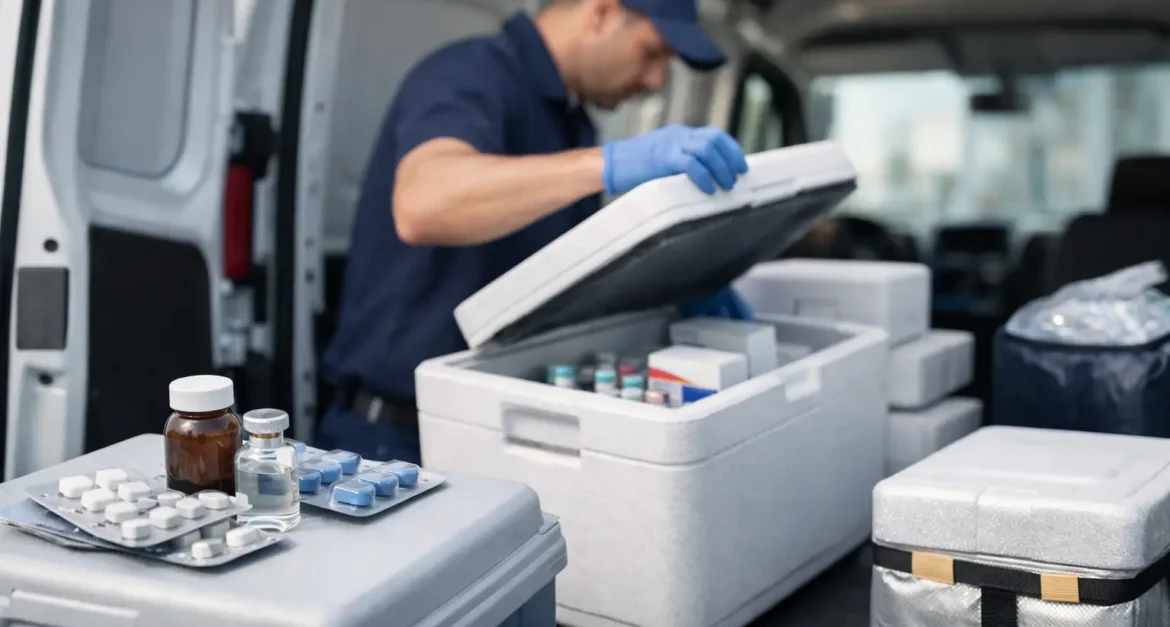
A delayed parcel is inconvenient. A delayed pharmaceutical consignment with an unproven temperature history can become a quality event, a stock write-off, or a risk to patient care. A specialist pharma courier service is therefore not simply a faster way to move medicines. It is a controlled transport operation designed to protect product integrity from collection through to verified handover.
For pharmacies, hospitals, laboratories, medical distributors and biotech businesses, the right provider brings certainty to an area where assumptions are costly. The vehicle, route, driver, temperature controls and delivery record must all support the condition in which the product is authorised to be stored and transported.
Why pharmaceutical delivery requires specialist control
Pharmaceutical products do not all travel under the same conditions. Some medicines require chilled transport, commonly within a defined 2°C to 8°C range. Others are frozen, ambient but temperature-sensitive, or need protection from excessive heat, cold, light or handling shock. Diagnostic samples, clinical trial materials and medical devices can bring further chain-of-custody requirements.
The key point is that a refrigerated vehicle alone does not guarantee a compliant journey. Temperature control must be appropriate to the product, monitored throughout transport and supported by records that can be reviewed when required. If a temperature excursion occurs, the response must be prompt, documented and aligned with the agreed escalation process.
Time matters just as much. A medicine can remain within its required range and still create an operational problem if it misses a hospital receiving slot, a pharmacy replenishment window or a laboratory processing deadline. This is why pharmaceutical transport needs coordinated planning, not a generic collection-and-delivery model.
What a pharma courier service should provide
A capable pharma courier service combines practical fleet capability with disciplined operational control. Before booking, the provider should understand what is moving, the required temperature range, collection and delivery times, packaging method, recipient requirements and the consequences of a delay.
Four controls should be clear from the outset:
- Validated temperature capability suited to chilled, frozen, ambient or multi-temperature loads, with equipment maintained for dependable performance.
- Real-time monitoring and GPS tracking that provide visibility of temperature and vehicle location while the consignment is in transit.
- Full traceability from collection to proof of delivery, including the people responsible for each handover.
- A defined exception process for traffic disruption, access issues, delayed recipients or any suspected temperature deviation.
These controls should work together. Location data without temperature data cannot demonstrate cold-chain integrity. Temperature data without clear delivery confirmation leaves a gap in custody. A fast response without a documented process can make an exception harder to investigate later.
Temperature data must be usable, not merely collected
A useful temperature record shows more than a final reading at delivery. It should provide evidence across the journey, enabling the customer to understand whether the product remained within the agreed range. For sensitive products, live alerts can give the operations team time to intervene before a minor issue becomes a failed delivery.
The exact level of monitoring depends on the product and quality requirements. A routine pharmacy replenishment run may need a different protocol from a clinical trial shipment or a high-value biologic. The right approach is proportionate control, agreed before collection, rather than applying one generic standard to every load.
Dedicated transport reduces unnecessary handling
Consolidated networks can be cost-effective for less sensitive freight, but they may introduce additional handling points, cross-docking and variable dwell times. For many pharmaceutical consignments, a dedicated same-day vehicle offers greater control. The consignment is collected, secured, monitored and delivered directly, with fewer opportunities for delay or mishandling.
That does not mean dedicated transport is automatically the right answer for every movement. Planned, repeatable distribution routes can benefit from scheduled temperature-controlled services, especially where delivery windows and volumes are predictable. Urgent replenishment, critical samples or stock-at-risk situations usually call for a more direct response.
Planning the journey before the vehicle arrives
Reliable pharmaceutical delivery begins before the driver reaches site. A clear booking brief prevents avoidable errors and lets the courier assign the right vehicle and operating plan.
The transport team should confirm the product temperature requirement, the acceptable delivery window, total journey time, number of packages, load dimensions and any handling restrictions. They also need practical site information: collection contacts, delivery contacts, out-of-hours access, security requirements, booking references and whether the recipient can accept the consignment immediately.
Packaging remains part of the overall control strategy. Qualified passive packaging may be appropriate for certain products and lane durations, while active refrigerated transport provides continuous environmental control for others. The correct option depends on the stability data, external conditions, duration, packaging performance and risk profile. A courier should not guess which arrangement is adequate.
For multi-drop routes, planning becomes more detailed. Each door opening can affect the load environment, and a vehicle carrying products at different temperature ranges needs properly separated, monitored compartments. Route order, unloading time and recipient readiness all affect the risk profile.
Visibility protects operations when plans change
Road transport is exposed to disruption: motorway incidents, severe weather, delayed loading, failed access or a recipient who is temporarily unavailable. The difference between a controlled service and a basic courier is what happens next.
A specialist operator monitors the journey, communicates early and acts against an agreed contingency plan. That may involve rerouting the vehicle, contacting the delivery site, arranging a revised handover or protecting the consignment in temperature-controlled conditions until the recipient is ready. The aim is not to promise that disruption never occurs. It is to maintain control when it does.
For pharmaceutical and medical teams, this visibility also supports internal decision-making. If a delivery is running late, the receiving department can adjust staffing, arrange access or protect downstream schedules. Reliable updates are operational information, not a courtesy.
Questions to ask before appointing a provider
Commercial pressure can make it tempting to select a courier on speed or price alone. Both matter, but neither confirms that the service is suitable for a temperature-sensitive pharmaceutical load. Procurement and operations teams should ask how the provider monitors temperatures, what records are available after delivery, and how excursions are identified and escalated.
It is also worth establishing whether the proposed vehicle is dedicated or part of a wider route, how many handling points are involved, and what happens if delivery cannot be completed on the first attempt. Ask who has responsibility for communicating with your team outside normal hours. Clear answers indicate an operator with a defined process rather than an improvised response.
For regular work, review performance over time. On-time delivery is one measure, but it should sit alongside temperature compliance, proof-of-delivery quality, exception reporting and responsiveness. A provider that reports accurately helps identify recurring issues before they affect supply continuity.
A practical fit for urgent and planned pharmaceutical transport
Pharmaceutical distribution often needs two capabilities at once: planned reliability for routine movements and immediate capacity when demand changes. Stock shortages, urgent hospital requirements, laboratory deadlines and failed deliveries can require a vehicle at short notice. Routine replenishment, meanwhile, needs consistent collection times and predictable recipient service.
MT Logistics Group supports both requirements through temperature-controlled vehicles, real-time monitoring, GPS tracking and traceable delivery across the UK. The operational focus is straightforward: assign the right vehicle, maintain the agreed conditions, keep the customer informed and complete the handover with evidence.
The best time to test a pharma courier is before a critical shipment is waiting on the loading bay. Agree the temperature profile, documentation, escalation contacts and delivery process in advance, then use that plan to protect every movement when timing and product condition leave no room for compromise.