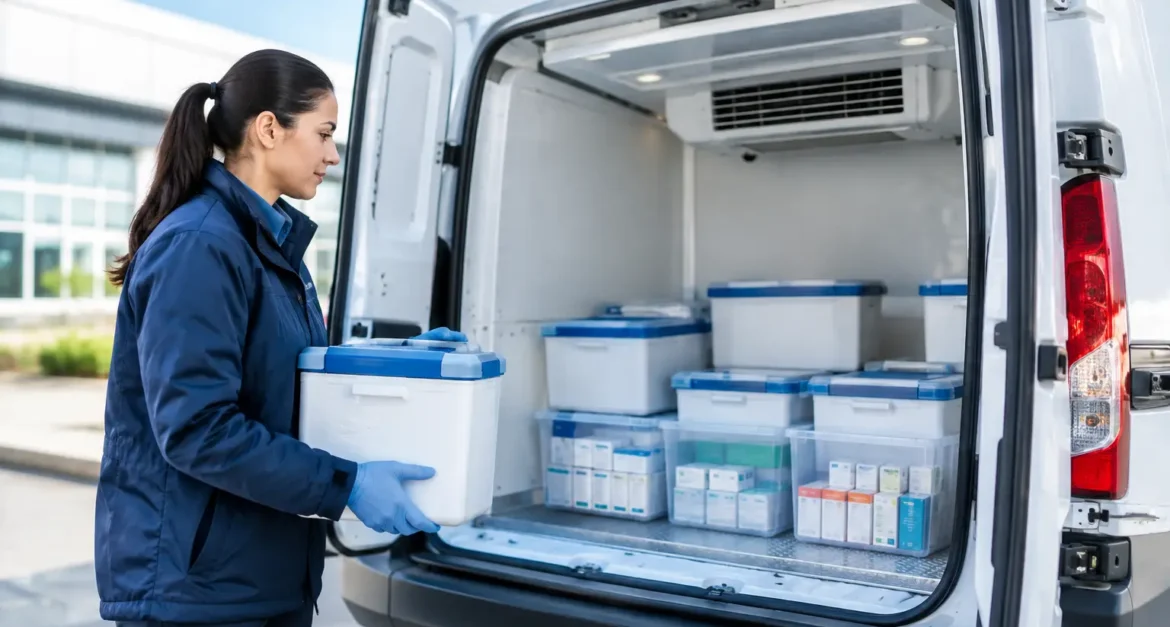
A medicine consignment can look perfectly acceptable at delivery and still be unusable if its required temperature has not been maintained. For pharmacies, hospitals, laboratories and medical distributors, the question is not simply, “can refrigerated vans carry medicines?” It is whether the vehicle, process and evidence trail can protect the product’s approved storage conditions for the entire journey.
The answer is yes, refrigerated vans can carry medicines safely – but only when they are selected, prepared and operated as part of a controlled pharmaceutical cold chain. A standard chilled vehicle may be suitable for some products. Others require a validated temperature range, defined loading limits, active monitoring, documented handover and a contingency plan if conditions change.
When refrigerated vans are suitable for medicines
Refrigerated vans are widely used for pharmaceutical and medical deliveries across the UK, particularly for temperature-sensitive products requiring controlled chilled transport. They can support planned distribution, urgent same-day movements, hospital replenishment, clinical trial materials and pharmacy deliveries, provided the transport specification matches the medicine’s labelled storage requirements.
Many products are commonly transported within a controlled 2°C to 8°C range. Others may require controlled ambient conditions, frozen transport or protection from excessive heat. These requirements are not interchangeable. A van set to a chilled temperature is not automatically suitable for every healthcare load, even if it feels cold when the doors open.
The vehicle must be capable of maintaining the required range in real operating conditions: during traffic delays, repeated door openings, summer heat, winter cold and unloading at a busy site. It also needs sufficient capacity for the consignment without blocking airflow around cartons or placing products against evaporators, doors or other temperature-risk areas.
Refrigerated vans carrying medicines need more than cooling
The refrigeration unit is only one element of safe medicine transport. Pharmaceutical distribution depends on control, traceability and proof. If a customer, quality team or regulator asks what happened during transit, the operator should be able to provide a clear answer.
Temperature range must match the product specification
The temperature target comes from the manufacturer’s storage and transport instructions, not from a courier’s standard setting. A chilled medicine may need to remain between 2°C and 8°C, while another product may tolerate a wider range. Some products must not freeze, which creates a particular risk when they are placed too close to cold air outlets or transported in very low external temperatures.
Before collection, the transport team should confirm the required range, journey duration, quantity, packaging format and destination handling arrangements. This prevents a common failure: putting a temperature-sensitive product into a cold vehicle without checking whether the actual conditions are appropriate for that product.
Monitoring must provide evidence, not reassurance alone
A dashboard display is useful, but it is not enough on its own. For medicine deliveries, calibrated digital monitoring should record the temperature throughout the journey and alert the operator to a developing deviation. GPS tracking adds location visibility, allowing teams to respond quickly if a vehicle is delayed, diverted or stationary for longer than planned.
The strongest approach combines real-time visibility with retrievable temperature records. This gives the sender confidence during transport and creates an auditable record after delivery. Where a temperature excursion occurs, the product should not simply be accepted or rejected on assumption. The incident needs to be assessed against the product’s stability data and the customer’s quality procedure.
Vehicle qualification and maintenance matter
A refrigerated van is only as dependable as its maintenance and performance checks. The refrigeration system, insulation, door seals, airflow and temperature sensors all affect its ability to hold a stable environment. Pre-use checks should confirm that the vehicle is clean, pre-cooled where required, functioning correctly and set to the agreed specification before loading starts.
For regular pharmaceutical routes, a qualified or validated transport solution provides greater assurance. This means performance has been assessed for the conditions it is expected to face, rather than assumed from the vehicle’s specification alone. The level of qualification required depends on the medicine, route profile, risk level and customer quality standards.
The risks are often at loading and delivery
Even a well-maintained refrigerated van can lose control through poor handling. Temperature exposure frequently occurs when products wait on a loading bay, doors are left open during multi-drop work, or a consignment is handed to a recipient who is not ready to receive it.
Good cold-chain discipline begins before the vehicle arrives. The collection point should have the shipment ready, correctly packed and clearly labelled. Products should move promptly from controlled storage to the pre-conditioned vehicle. At delivery, the driver needs a named contact, a confirmed time window and instructions for what to do if the site is closed, access is delayed or the receiving area cannot accept the goods.
For higher-risk consignments, direct delivery is usually safer than a complex multi-drop route. Multi-drop pharmaceutical distribution can be effective, but it requires careful route planning, disciplined door management and sufficient temperature recovery between stops. The commercial benefit of combining loads must never outweigh the risk to product integrity.
Packaging and vehicle control work together
Refrigerated transport does not remove the need for suitable pharmaceutical packaging. Insulated shippers, qualified cool packs, thermal covers or other protective packaging may be required depending on the product, journey time and exposure risk. Packaging provides a protective buffer. The refrigerated vehicle maintains the controlled environment around it.
This matters where deliveries include long waits, repeated handling or limited access to temperature-controlled storage at the destination. It also matters for small consignments in a large van, where placing a package correctly is essential to avoid localised cold or warm spots.
There is a trade-off. More packaging can improve protection, but it may add cost, weight and preparation time. A validated refrigerated van may allow a simpler packaging solution for some routes, while a higher-risk journey may justify both active vehicle control and enhanced packaging. The right decision should be based on the medicine’s requirements and the real journey profile, not a one-size-fits-all rule.
What pharmaceutical customers should ask a transport provider
Before assigning medicine deliveries to a refrigerated van operator, establish how the service will be controlled in practice. Ask whether the provider can operate within your specified temperature range, supply temperature records, track the vehicle in real time and manage an exception without delay.
You should also understand the loading process, cleaning standards, maintenance regime, driver training and proof-of-delivery procedure. For urgent work, confirm what happens if the allocated vehicle breaks down, traffic closes a route or the destination changes at short notice. A reliable provider plans for disruption before it affects the consignment.
Where medicines are particularly valuable, sensitive or time-critical, a dedicated vehicle is often the most controlled option. It reduces handling points, avoids unrelated freight and gives the sender greater control over collection and delivery timing. MT Logistics Group supports temperature-controlled and time-critical medicine movements with monitored refrigerated vehicles, GPS visibility and clear delivery traceability across the UK.
A practical process for safe medicine transport
A controlled pharmaceutical journey starts with clear instructions. The sender provides the required temperature range, product details, collection and delivery windows, packaging information and any site-specific protocols. The transport team assigns a suitable vehicle and checks that it is ready for the agreed conditions.
At collection, the driver verifies the consignment and loads it in a way that protects airflow and prevents damage. Monitoring continues in transit, while the control team can track progress and respond to delays. At delivery, the recipient receives the goods promptly and the handover is recorded. Temperature data and delivery evidence are then retained in line with the agreed process.
That discipline is what separates cold transport from a dependable medicine delivery service. The goal is not merely to move a parcel in a chilled space. It is to preserve product quality, maintain compliance and give every party confidence that the medicine arrived exactly as intended.
For routine replenishment or an urgent clinical delivery, choose the transport control level around the product’s actual risk. When the vehicle, monitoring, packaging and handling process work together, refrigerated vans can provide a reliable, traceable way to keep medicines protected from collection through to receipt.