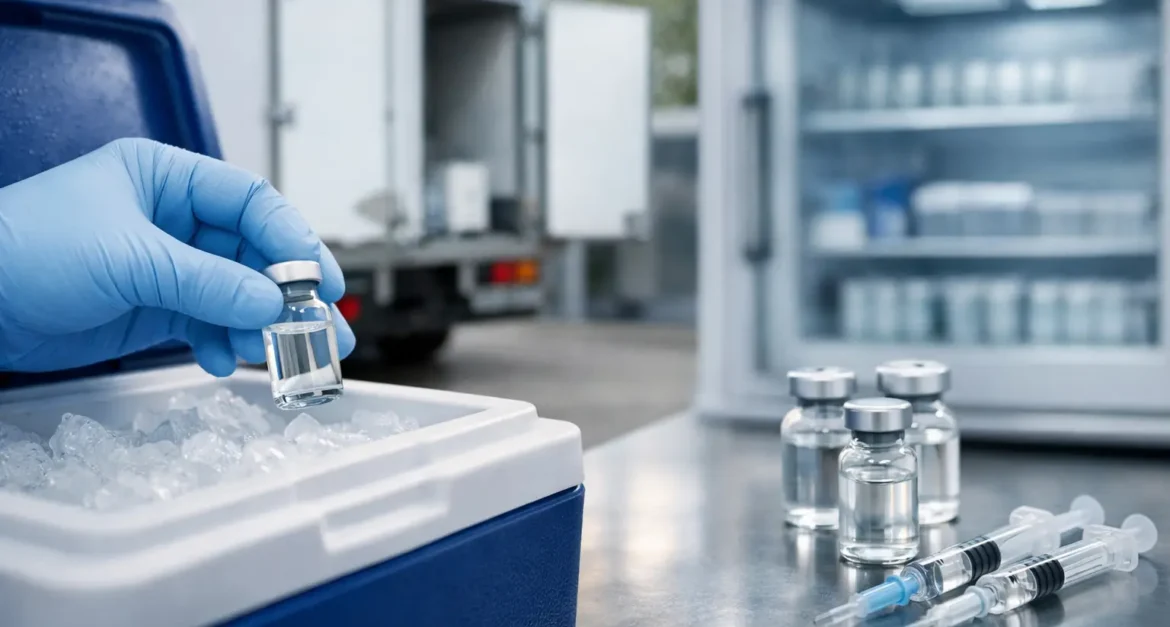
A vaccine can leave the manufacturer in perfect condition and still become unusable before it reaches a patient if the temperature is not controlled at every handover. That is why the question, what is cold chain management of vaccines, matters far beyond warehousing or transport. It is a patient safety issue, a compliance issue and, for anyone responsible for healthcare distribution, a trust issue.
Cold chain management of vaccines is the end-to-end process of storing, handling and transporting vaccines within strictly defined temperature ranges so their potency, safety and effectiveness are preserved. It covers everything from refrigerated storage and insulated packing to validated vehicles, continuous temperature monitoring, documented handovers and contingency planning when something goes wrong.
What is cold chain management of vaccines in practice?
In practical terms, vaccine cold chain management is not a single refrigerated journey. It is a controlled system. Vaccines may move from manufacturer to central storage, from central storage to regional distribution, and then on to hospitals, pharmacies, GP surgeries or vaccination sites. At each stage, the product must remain within its required temperature range, with full visibility and traceability.
For most vaccines, that range is typically between 2C and 8C, although some products require frozen or ultra-low temperature conditions. The exact requirement depends on the formulation, shelf life and manufacturer guidance. This is where operational discipline matters. A product that is too warm may degrade. A product that freezes when it should not can also be damaged, even if it still looks normal from the outside.
That point is often missed. Cold chain failure is not just about heat exposure. For many vaccines, accidental freezing is equally serious. A poorly set refrigeration unit, unsuitable packaging or a delay on a winter loading bay can all cause product compromise.
Why vaccine cold chain management is so tightly controlled
Vaccines are biological products. They are sensitive to temperature fluctuation, light exposure and handling errors in ways that many standard goods are not. Once potency is lost, it cannot be restored by simply cooling the product back down.
The implications are significant. If a vaccine has been exposed to temperatures outside specification, healthcare providers may have to quarantine stock, assess excursion data, discard doses and investigate the cause. That creates cost, waste and operational disruption. More importantly, it can affect immunisation programmes and public confidence.
For businesses and healthcare organisations involved in pharmaceutical distribution, the stakes are high. Good cold chain management reduces the risk of spoilage, prevents avoidable stock loss and supports regulatory compliance. It also protects the reputation of every organisation in the supply chain.
The core elements of vaccine cold chain control
Effective vaccine cold chain management depends on a series of linked controls rather than one piece of equipment. Temperature-controlled storage is the obvious starting point, but it is only part of the picture.
Products must be held in suitable medical refrigeration or validated cold rooms, with calibrated monitoring devices and alarm systems in place. Stock rotation matters, as does correct loading, because airflow inside a unit can affect consistency. Vaccines cannot simply be placed wherever there is space.
Transport then becomes the next critical control point. Vehicles, containers and packaging must be appropriate for the route duration, ambient conditions and product profile. A short urban run and a longer multi-drop route may require very different handling plans. The transport method has to match the risk.
Documentation is equally important. Every movement should be traceable, from batch details and dispatch records to temperature logs and proof of delivery. If there is a query later, the chain of custody needs to be clear.
Finally, trained people sit behind the whole process. Even well-specified equipment cannot compensate for poor handling. Staff need to understand storage tolerances, loading discipline, excursion procedures and what to do if a unit fails or a delivery is delayed.
Where vaccine cold chains usually fail
Most failures are not dramatic. They are often small lapses that build into major risk. A fridge door is opened too often. A shipment waits too long before loading. A logger is missing or not checked. A driver reaches site on time but the consignee is not ready to receive the goods. A delivery is left in an uncontrolled area during handover.
These are operational issues, not theoretical ones. They happen when the cold chain has weak points between storage, transport and receipt.
There is also a common assumption that any refrigerated vehicle is suitable for vaccine distribution. That is not always true. Vaccine transport requires tighter control, better visibility and more disciplined process management than general chilled distribution. Validation, calibration, route planning and real-time monitoring matter because the tolerance for deviation is extremely low.
What good vaccine cold chain management looks like
A well-run vaccine cold chain is controlled before the vehicle moves. The temperature range is defined, the packaging method is confirmed, the equipment is checked and the route is planned around time sensitivity and receiving conditions.
During transit, there is active monitoring rather than blind trust. Temperature data should be available throughout the journey, not just reviewed after delivery. If there is an issue, the response needs to be immediate. That may mean intervention, rerouting or product quarantine on arrival.
At delivery, handover is fast and documented. The receiving team is prepared, the shipment is inspected and temperature records are retained. Control continues until the product is safely back in compliant storage.
This is where specialist cold-chain providers add real value. It is not simply about moving goods from A to B. It is about maintaining validated conditions, preserving product integrity and giving the customer full visibility throughout the journey.
The role of monitoring, validation and traceability
If you cannot prove a vaccine stayed within range, you may struggle to prove it remained fit for use. That is why monitoring and traceability sit at the centre of vaccine cold chain management.
Temperature data loggers, digital sensors and vehicle monitoring systems provide the evidence trail. They show whether conditions stayed within specification, when fluctuations occurred and how long any excursion lasted. For regulated healthcare logistics, this data is not an optional extra. It supports release decisions, investigations and audit readiness.
Validation is just as important. A vehicle or shipping method should not be assumed to perform correctly simply because it is refrigerated. It needs to be shown, under expected operating conditions, that it can maintain the required product temperature for the planned journey. Seasonal variation matters here. What works on a mild spring morning may not be sufficient during a summer heatwave or a freezing overnight run.
Why it depends on the product and the route
Not every vaccine movement carries the same risk profile. A short same-day delivery to a local clinic differs from a national distribution schedule with multiple delivery points. The packaging, vehicle specification, route timing and contingency measures should reflect that.
There are trade-offs to manage. Passive packaging can be effective for shorter periods but may be less suitable for extended delays. Dedicated transport offers greater control but can cost more than consolidated distribution. Multi-drop routing may improve efficiency, but for high-priority or highly sensitive products, direct delivery may be the safer option.
The right model depends on product sensitivity, delivery timeframe, ambient conditions, handover complexity and the consequences of failure. That is why vaccine logistics should be planned around the product, not forced into a standard transport template.
What is cold chain management of vaccines really protecting?
At one level, it protects temperature-sensitive stock. At a more important level, it protects clinical effectiveness. A compromised vaccine may not perform as intended, which means the cold chain is directly connected to patient outcomes.
It also protects compliance. Healthcare and pharmaceutical supply chains are expected to show control, not just claim it. When audits, inspections or product queries arise, records, monitoring data and validated processes become essential.
And it protects confidence. Healthcare providers need assurance that the products they receive are safe to use. Distribution managers need confidence that there will be no hidden gaps between dispatch and delivery. For a specialist logistics partner such as MT Logistics Group, that comes down to precision, visibility and disciplined execution at every stage.
Cold chain management of vaccines is, ultimately, about removing uncertainty. When every transfer point is controlled, every condition is monitored and every handover is documented, you are not leaving product quality to chance. You are protecting the integrity of the vaccine all the way to the point where it is needed most.