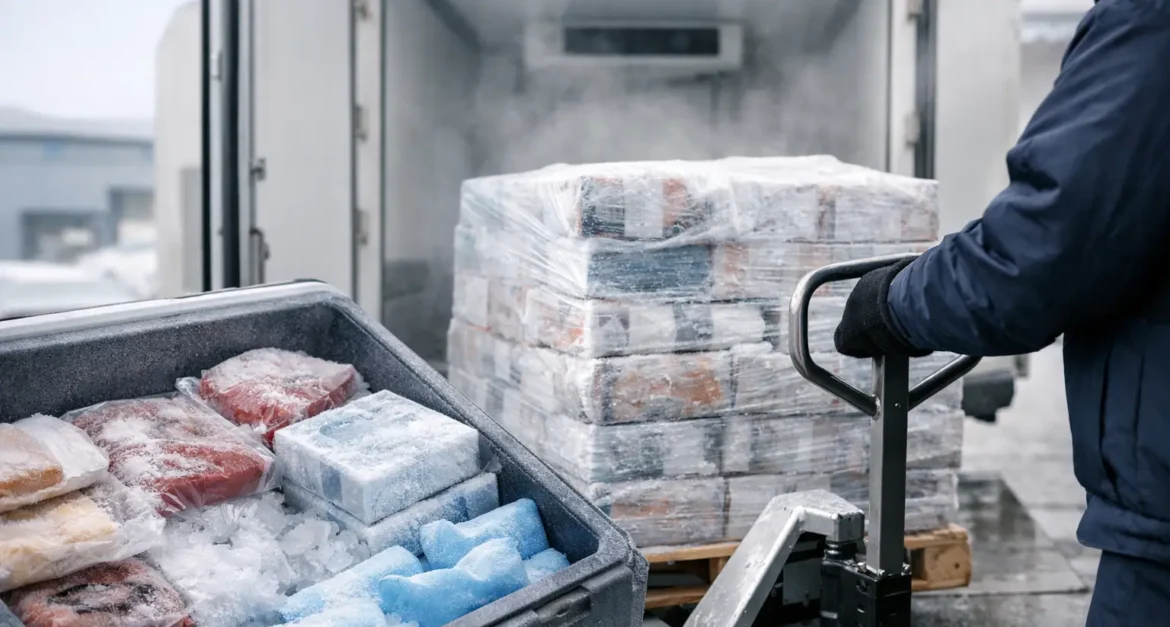
A frozen consignment can look perfectly acceptable at the point of delivery while carrying damage that began hours earlier. Softened edges, partial thawing, crushed cartons, poor airflow or an unrecorded temperature excursion can all shorten shelf life, compromise safety and create a costly dispute. Preventing frozen product damage depends on controlling the whole journey, not simply setting a refrigerated vehicle to a low temperature.
For food businesses, the operational benchmark is commonly -18°C or below, but the required transport condition must always follow the product specification, customer agreement and applicable legislation. For pharmaceutical, medical or specialist products, the approved temperature range and handling instructions take priority. The right approach is precise: understand the required condition, protect it at every handover and retain evidence that it was maintained.
Start with a clear frozen transport specification
The first control point sits before collection. A transport provider needs more than a delivery postcode and pallet count. They need to know the product’s required temperature range, whether the stated limit applies to air temperature or product core temperature, the acceptable delivery window, packaging format, stack height, and any segregation requirements.
This matters because frozen goods do not all behave in the same way. Ice cream, meat, prepared meals, bakery products and temperature-sensitive healthcare stock can have different tolerances, packaging strengths and loading requirements. A vehicle running at an appropriate setpoint may still be unsuitable if the load blocks evaporator airflow, the delivery has multiple door openings, or the product has not been fully frozen before loading.
Agree the escalation process in advance as well. If a temperature alarm occurs, the driver and operations team should know who to contact, what checks to make, whether to continue, and how to preserve the temperature record. Decisions made calmly from a documented plan are safer than decisions made at a loading bay under time pressure.
Preventing frozen product damage at loading
Many avoidable temperature issues start before the vehicle leaves site. Frozen stock should be held in a controlled freezer environment until the vehicle is ready to load. Leaving pallets in an ambient marshalling area while paperwork is completed exposes cartons to unnecessary warming and condensation risk.
The loading sequence should be organised so that the vehicle doors are open for the shortest practical time. Pre-cool the load space where required, confirm it is clean, dry and free from odours, and check that the refrigeration unit is operating correctly before product enters. A warm vehicle compartment can draw heat into outer cases quickly, particularly during summer collections or when high volumes are loaded at once.
Physical protection is equally important. Cartons become vulnerable when pallets are poorly wrapped, overhanging, stacked beyond their strength or placed where they can shift in transit. Use suitable pallet configuration, secure the load without restricting airflow, and keep products clear of areas where direct cold air could cause localised freezing or packaging brittleness. The aim is stable product, stable pallets and clear air circulation.
Where products are collected from several sites, collection timings need realistic planning. A multi-pickup route may suit the commercial requirement, but only if the vehicle capacity, compartment configuration and route duration can maintain the required condition for every consignment.
Keep the cold chain controlled on the road
A refrigeration unit is not a substitute for active transport management. It must be correctly specified for the ambient conditions, load size, delivery pattern and required setpoint. A fully loaded vehicle on a summer multidrop route performs differently from a lightly loaded dedicated run in winter.
Real-time digital temperature monitoring gives operations teams the visibility to identify an issue while there is still time to act. It should be paired with GPS tracking, because temperature data without location context makes it harder to assess the cause and urgency of an alarm. A delay at a customer site, an extended door opening or an unplanned diversion can all affect the thermal condition of a frozen load.
The response to an alert should be proportionate and documented. First, verify whether the reading reflects air temperature, a sensor position issue or a genuine deviation. Then check the refrigeration unit, door status and vehicle location. If intervention is required, operations should direct the vehicle to the safest available solution, such as closing doors, reducing dwell time, arranging priority unloading or moving the consignment into suitable cold storage. The important point is speed with control, not guesswork.
Door discipline protects frozen loads
Repeated door openings are one of the greatest risks in frozen multidrop distribution. Each opening introduces warmer, often humid air. That air can raise compartment temperature, create frost and condensation, and make the refrigeration system work harder to recover.
Route design can reduce this exposure. Group deliveries by area, use realistic unloading allowances, and avoid combining a frozen route with unnecessary collection activity. At site, drivers should confirm the receiver is ready before opening the doors and unload in a planned sequence. If a customer cannot receive the stock promptly, keeping the load space closed while the issue is resolved is often the better protection.
Compartmentalised vehicles can provide an effective solution for mixed chilled, frozen and ambient loads, but only when the load plan supports the equipment. Segregation, access order and door use must be considered before dispatch. A multi-temperature vehicle offers flexibility; it does not remove the need for disciplined handling.
Protect the final handover, not just the journey
Delivery is where cold-chain responsibility is tested most closely. The receiver should have an appropriate frozen storage area ready, with sufficient capacity to put stock away immediately. A product left on a shop floor, in a rear yard or beside a kitchen freezer is still at risk, even if it travelled under correct control.
Drivers should record the delivery time, obtain proof of delivery and report visible packaging damage, refused stock or any condition that could affect product integrity. For higher-risk consignments, agreed temperature checks at handover may be appropriate. The right method depends on the product, the customer’s quality system and the risk profile of the delivery.
This evidence is more than administration. Full traceability helps businesses investigate complaints, demonstrate due diligence and distinguish a genuine transport issue from a problem that occurred before collection or after receipt. When a customer asks what happened to a pallet, a reliable cold-chain partner should be able to provide a clear account of its journey.
Build contingency into the frozen supply chain
Frozen logistics is most dependable when disruption has already been considered. Traffic closures, vehicle faults, refrigeration alarms, late collections and inaccessible delivery sites do happen. The risk comes from having no controlled response when they do.
A practical contingency plan should cover standby vehicle availability, escalation contacts, access to suitable cold storage, prioritised delivery decisions and communication with receiving sites. For urgent stock, a dedicated vehicle may provide more control than a complex shared route. For regular retail or hospitality distribution, scheduled routes and planned multidrops can be more efficient, provided there is enough capacity and recovery time built into the operation.
There are trade-offs. The lowest transport price may rely on tight schedules, multiple stops or limited flexibility when conditions change. A service designed around monitoring, validated equipment, trained drivers and rapid intervention can cost more, but it reduces the much larger cost of rejected loads, wasted stock, lost sales and reputational damage.
Use temperature data to improve every route
Temperature records should be reviewed, not simply stored. Look for recurring patterns: a particular loading site where dwell time is too long, a delivery that regularly causes alarms, an access restriction that delays unloading, or a vehicle configuration that struggles on a specific route.
Those findings allow practical improvements. Collection slots can be moved, delivery sequences changed, packaging strengthened, vehicle capacity adjusted or receiving teams given clearer instructions. Continuous improvement is especially valuable for businesses scaling frozen distribution, adding new retail sites or managing seasonal volume peaks.
MT Logistics Group supports frozen food transport with temperature-controlled vehicles, real-time monitoring, GPS visibility and documented delivery traceability across UK routes. The focus is straightforward: keep products within their required condition and give customers confidence that any exception will be identified and managed quickly.
Frozen product protection is earned in the small operational decisions: loading only fully frozen stock, closing doors promptly, responding to alarms early and ensuring the receiver is ready. Put those controls in place before the next consignment leaves the freezer, and every delivery starts from a position of control.