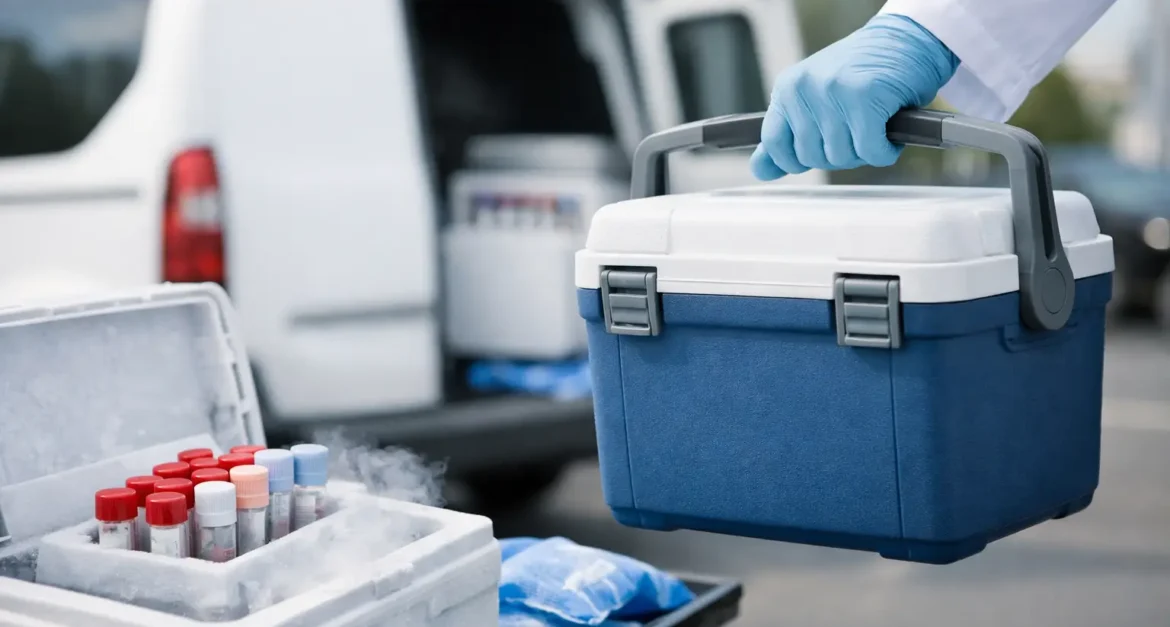
A trial sample can represent a patient visit that cannot be repeated, a critical timepoint in a study, or months of laboratory work. Once its stability is compromised or its chain of custody is unclear, the consequences can extend far beyond one consignment. Protecting clinical trial samples therefore requires more than a refrigerated vehicle. It requires a planned, documented and actively controlled transport process built around the protocol, sample type and delivery deadline.
For clinical teams, laboratories, sponsors and CROs, transport must preserve sample integrity while maintaining the evidence needed to demonstrate that it has been handled correctly. Temperature, time, security and communication must all remain under control from collection through to confirmed receipt.
Why clinical trial sample transport carries higher risk
Clinical trial samples are not standard medical consignments. Blood, plasma, serum, tissue, investigational medicinal product-related materials and biological specimens can each have different stability profiles, packaging requirements and urgency. Some must remain chilled at 2°C to 8°C, others frozen at -20°C or below, while certain materials require dry ice or specialist cryogenic handling.
The correct solution depends on the protocol. A temperature range suitable for one sample may invalidate another, and an acceptable transit duration on a routine route may be unsuitable when a sample has a short processing window. The key question is not simply whether a vehicle is refrigerated. It is whether the full transport configuration has been selected and managed to meet the sample’s defined conditions.
There is also an evidential requirement. If a monitor records an excursion, the sponsor or laboratory needs clear information: when it occurred, how long it lasted, what the sample experienced and what action was taken. Without reliable records, a sample can become difficult to use even where there is no obvious physical damage.
Start with a transport risk assessment
Before collection is booked, the sender, receiving laboratory and logistics provider should agree the critical details. This creates a practical transport plan rather than relying on assumptions at the point of handover.
The assessment should define the required temperature range, permitted transit time, collection and delivery windows, packaging method, monitoring requirements, named contacts and escalation route. It should also establish whether samples can travel with other goods, whether segregation is required and what security controls apply.
This is especially important for multi-site studies. A route from a city-centre clinic to a UK laboratory may be straightforward, but collections from remote sites, late-day appointments or deliveries requiring an onward European road movement need additional contingency planning. The intended route should allow sufficient time for secure collection, careful loading, controlled transit and laboratory acceptance, not merely the shortest estimated journey.
Temperature control must match the protocol
A validated temperature-controlled vehicle helps protect ambient, chilled and frozen consignments during transit. However, the vehicle setting alone is not enough. Packaging, load placement, door-opening frequency, journey duration and external weather conditions can all affect the temperature experienced by the sample.
For chilled samples, pre-conditioned packaging and a vehicle maintained within the required range may be appropriate. For frozen material, an approved passive shipper, dry ice solution or dedicated freezer capability may be necessary, depending on the required set point and journey length. Cryogenic shipments require their own specialist equipment, safety measures and trained handling procedures.
The approach should be proportionate to the risk. Over-specifying a solution can add unnecessary cost and handling complexity. Under-specifying it can lead to an excursion that places valuable samples and study timelines at risk. The protocol, stability data and route assessment should determine the control method.
Build visibility into every handover
Clinical samples can change hands several times: from clinical staff to the courier, from driver to laboratory reception, and sometimes between operational teams during an out-of-hours delivery. Each handover is a potential point of error unless it is controlled.
A clear chain of custody records who released the consignment, who received it, the relevant times, the condition of the packaging and any exception identified. Drivers should confirm collection against the booking details, use the correct labels and handle samples according to agreed instructions. At delivery, the receiving team should have advance notice where required, particularly for urgent or temperature-sensitive arrivals.
GPS vehicle tracking provides location visibility throughout the journey. Digital temperature monitoring adds the critical environmental record. Together, these tools allow logistics coordinators to confirm that the vehicle is progressing to plan and that the required conditions are being maintained.
Real-time alerts can be particularly valuable where there is a delay, an unexpected route restriction or a developing temperature issue. Early action gives the operations team more options, such as contacting the receiving site, arranging an alternative vehicle or protecting the consignment before a minor issue becomes a reportable incident.
Use packaging as part of the cold chain
Transport packaging is a control measure, not an afterthought. It must protect the primary sample container from breakage, leakage and temperature exposure while remaining suitable for the chosen transport mode. Absorbent material, secondary containment, tamper-evident seals and clear external identification all support safe handling.
For biological materials, the sender must ensure that classification, packaging and documentation are appropriate to the contents and journey. A logistics provider can operate to agreed handling requirements, but accurate sample information must be supplied at booking. This includes hazards, temperature instructions, dry ice content where applicable, delivery contact details and any site-specific rules.
Packaging should also be tested against reality. A container that performs well in a controlled trial may behave differently during a long collection round, in summer heat, during winter loading or when waiting at a laboratory goods-in area. Periodic review of lane performance helps confirm that the packaging and transport plan remain suitable.
Plan for exceptions before they happen
The strongest sample transport operations do not assume that every journey will run perfectly. They prepare for disruption. Traffic incidents, site access delays, missed collections, vehicle faults, severe weather and laboratory closures can all affect a time-critical consignment.
A documented contingency plan should set out who is contacted, who has authority to make decisions and what alternatives are available. This may include standby refrigerated vehicles, direct same-day delivery, approved secure holding arrangements or a revised handover location. For urgent collections, a dedicated vehicle can reduce the risk created by multiple stops and variable loading activity.
If a temperature deviation occurs, the correct response is controlled assessment, not guesswork. Protect the sample, preserve the monitoring data, record the event and notify the relevant study contact promptly. The sponsor or laboratory can then assess the excursion against approved stability criteria. The courier should provide factual, time-stamped information that supports that decision.
Choose a logistics partner with operational control
Clinical trial transport needs more than capacity on a route. Look for a provider that understands time-critical healthcare movements, can supply the appropriate temperature-controlled vehicle and provides full traceability from collection to delivery.
Ask how temperatures are monitored, how drivers receive sample-specific instructions, what happens if a vehicle is delayed and how proof of delivery is captured. Confirm whether the provider can support direct collections, dedicated day-rate vehicles, scheduled laboratory runs and urgent same-day requirements. The answers should be operationally specific, not general assurances.
MT Logistics Group supports temperature-controlled, time-critical movements with refrigerated vehicles, GPS tracking and digital temperature monitoring. For clinical trial work, that combination gives study teams a controlled transport process and the visibility needed to manage it with confidence.
Protecting clinical trial samples means protecting the study
A successful delivery is not simply a parcel arriving on time. It is a sample arriving within its required conditions, with its identity, handling history and temperature evidence intact. When transport is planned around the protocol and monitored from end to end, clinical teams can focus on the study rather than chasing a consignment.
For each new route or protocol amendment, review the sample journey before the first collection. A short operational check at the start can prevent an avoidable deviation when the stakes are highest.