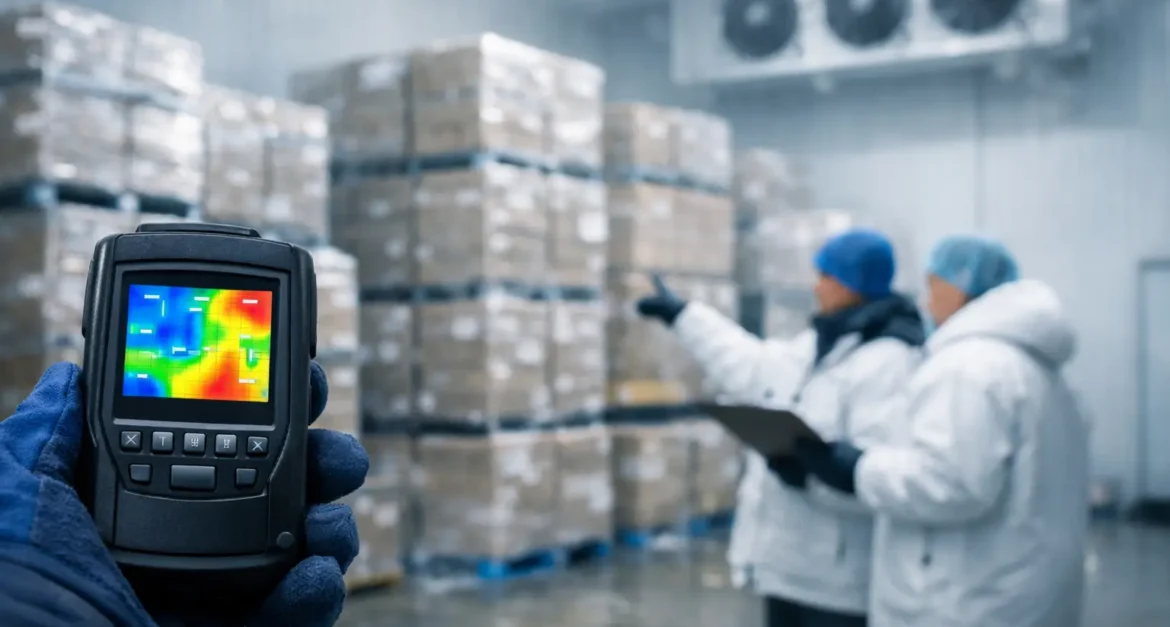
A refrigerated vehicle can show the correct setpoint on its control panel while parts of the load space are warmer or colder than the product specification allows. Door openings, air circulation, loading patterns, outside weather and vehicle design all affect the real temperature experienced by goods. That is why the question of when is thermal mapping required matters: it provides evidence that controlled conditions are achieved throughout the space, not simply at one sensor location.
For businesses moving pharmaceuticals, clinical materials, fresh food, frozen products or other sensitive goods, thermal mapping is a practical risk-control measure. It identifies temperature variation, supports validation and gives operations teams the information needed to protect product integrity before a live shipment is placed at risk.
What thermal mapping proves
Thermal mapping is a planned study that records temperature at multiple points within a vehicle, trailer, warehouse, cold room or insulated transport container over a defined period. Calibrated data loggers are positioned across the usable space, including areas likely to be affected by airflow limitations, door openings or external heat.
The aim is to identify hot and cold spots, confirm pull-down and recovery performance, and demonstrate whether the environment remains within the required temperature range under representative operating conditions. A map is not just a collection of readings. It is documented evidence that equipment, procedures and loading arrangements can maintain the conditions a product requires.
This differs from routine temperature monitoring. Monitoring confirms what happens during individual journeys or storage periods. Mapping establishes where sensors should be placed, what risks exist within the space and whether the overall system is suitable for its intended use. Both have a role in a controlled cold chain.
When is thermal mapping required?
There is no single rule that makes thermal mapping mandatory for every refrigerated delivery. The requirement depends on the product, the applicable regulation or quality standard, customer agreements and the risk associated with a temperature deviation.
It is generally required, or strongly expected as part of a validation programme, when the transport or storage environment supports products with defined and critical temperature limits. Pharmaceutical and healthcare distribution is the clearest example. Under Good Distribution Practice principles, organisations must be able to show that medicinal products are stored and transported under the conditions specified by the manufacturer. This means understanding the actual thermal performance of the vehicle, route and packaging system rather than relying on a nominal setpoint.
Thermal mapping is also commonly needed where a quality management system requires qualification of temperature-controlled assets. A new refrigerated vehicle, cold store, distribution hub or multi-temperature compartment should be assessed before it enters service. The same applies when a client requires validation evidence as part of supplier approval or tender requirements.
For food operators, the legal and commercial driver may be different, but the operational need can be just as strong. Businesses must maintain appropriate temperature control and protect food safety. Where high-value chilled or frozen goods are being carried, mapping helps demonstrate that a vehicle configuration can consistently meet the agreed specification across the full load area. It is particularly valuable for long-distance distribution, multidrop work and deliveries exposed to repeated door openings.
Situations that trigger a new mapping study
Thermal mapping should not be treated as a one-off exercise filed away when a vehicle is commissioned. A repeat study is appropriate after a material change that could alter temperature performance. Examples include replacing refrigeration equipment, changing insulation, converting the vehicle layout, adding partitions for multi-temperature work or changing the operating setpoint.
It should also be reviewed after major repairs, a prolonged equipment failure, repeated temperature excursions or a change in intended use. A vehicle previously used for frozen distribution may need further qualification before carrying chilled products with a narrower permitted range. Similarly, adding a new route profile, such as extended overnight work or frequent city-centre multidrops, can introduce conditions that were not represented in the original study.
Seasonality matters too. Ambient temperatures place very different demands on refrigeration systems in winter and during a summer heatwave. Risk-based validation may therefore include studies in challenging seasonal conditions, or evidence that adequately represents them.
Transport scenarios where mapping adds real control
A single-drop journey in a fully loaded refrigerated van is not the same as a 20-stop retail route. Each delivery opens the doors, exchanges conditioned air for outside air and changes the load configuration. Near-empty compartments can behave differently from fully loaded ones, while stock positioned close to an evaporator may be exposed to lower temperatures than goods at the rear doors.
For pharmaceutical, medical and laboratory consignments, these variables can be critical. A shipment may have a narrow approved range, and an excursion can lead to quarantine, investigation or product disposal. Mapping supports a transport plan that specifies the appropriate vehicle, loading pattern, monitoring locations and delivery process.
Multi-temperature transport requires particular care. Partitioned vehicles must demonstrate that each compartment can achieve and sustain its designated range without adversely affecting another zone. The assessment should consider the actual configuration in use, including partition positions, loading volume and door activity. A correct temperature in the frozen section does not prove that the chilled or ambient compartment is protected.
How a thermal mapping exercise works
A reliable study begins with a clear protocol. This defines the product temperature requirement, the asset being assessed, the test duration, logger locations, acceptance criteria and the operating conditions to be represented. It should also identify what will happen if results fall outside the permitted range.
Calibrated data loggers are then placed throughout the space. Locations normally include the front and rear, high and low positions, points close to doors, areas near refrigeration outlets and positions where airflow may be restricted. The number of loggers should be proportionate to the vehicle or storage area and the complexity of the operation.
During the exercise, the vehicle or facility operates under realistic conditions. For transport, this may include a representative load, planned setpoint, vehicle movement, scheduled door openings and a typical journey duration. Testing an empty, stationary vehicle with the doors closed may have limited value if the normal operation involves frequent drops and mixed loads.
Once data is collected, it is assessed against the acceptance criteria. The final report should show the temperature profile at each location, identify any hot or cold spots, record deviations and set out corrective actions where needed. These actions might include changing the loading plan, revising sensor placement, repairing seals, adjusting airflow management or selecting a different vehicle configuration.
What good evidence looks like
A defensible mapping record is clear enough for an operations manager, quality lead or auditor to understand exactly what was tested and why. It should include equipment identification, calibration status for measuring devices, test dates, environmental conditions, load configuration, setpoints, door-opening activity, raw data, results and approval of the outcome.
The report should also connect the result to day-to-day controls. If mapping identifies a warm area near the rear doors, routine monitoring should not be positioned only at the coldest point near the refrigeration unit. If a loading arrangement is needed to maintain airflow, that requirement should appear in driver and warehouse instructions.
The cost of relying on assumption
Thermal mapping does require planning, calibrated equipment and operational time. For lower-risk, short-distance work, the level of study may be simpler than it would be for pharmaceutical distribution. However, avoiding the exercise where validation is expected can be far more costly.
Without evidence of thermal performance, a temperature deviation is harder to investigate. Teams may be unable to determine whether the issue was isolated, route-related, caused by a loading error or built into the vehicle configuration. That uncertainty can lead to rejected stock, unnecessary waste, delayed release decisions and damaged customer confidence.
The most effective approach is risk-based. Match the mapping scope to the sensitivity of the product, the tightness of the temperature range, the complexity of the operation and the consequences of failure. Then combine validated equipment with live digital monitoring, GPS visibility, trained handling and a clear escalation process.
For organisations that cannot accept guesswork in the cold chain, thermal mapping turns a vehicle or storage space into a controlled, evidenced part of the operation. MT Logistics Group applies that same focus on traceability and temperature control to help customers move sensitive goods with the assurance their supply chain demands.