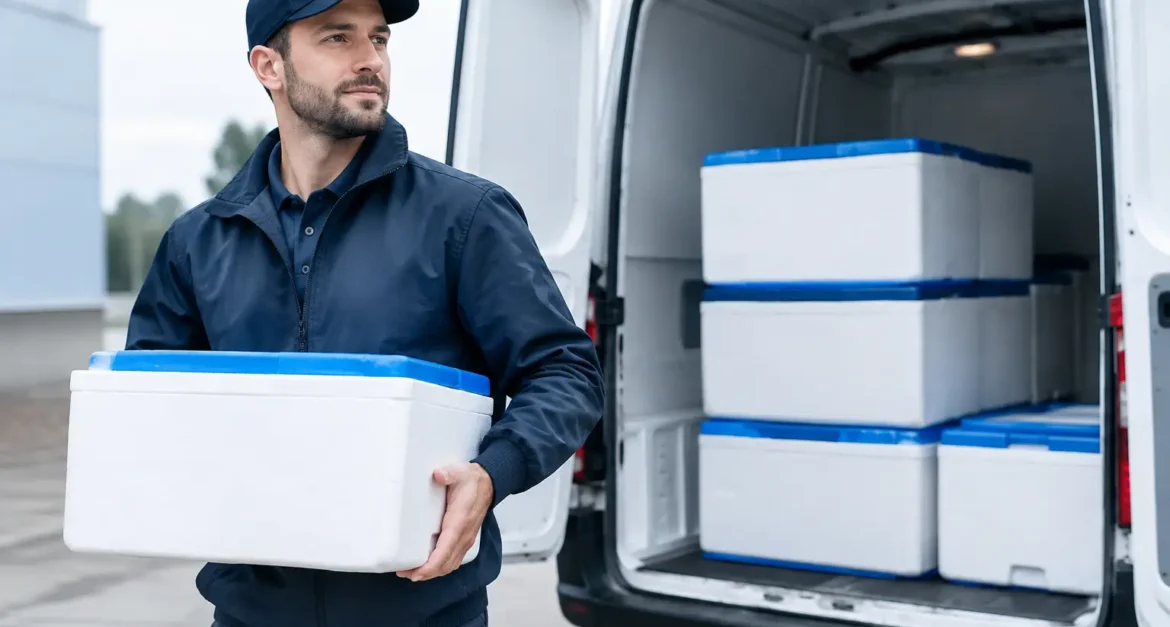
A chilled courier, frozen delivery, same day courier and temperature controlled courier service may sound like four separate requirements. In practice, they often form one operational brief: collect a sensitive consignment quickly, hold it within specification, provide evidence of control, and deliver within a defined window. For food, pharmaceutical, healthcare and hospitality businesses, a late or poorly managed delivery can mean more than inconvenience. It can create waste, lost sales, compliance exposure and damage to customer trust.
The right transport solution starts with the product, its permitted temperature range and the consequence of a deviation. Speed matters, but speed without control is not a cold-chain solution.
When a chilled courier is the right choice
Chilled transport is designed for products that must remain within a refrigerated range, commonly between +2°C and +8°C or +2°C and +5°C depending on the product specification. Fresh produce, dairy, prepared foods, chilled ingredients, certain medicines and clinical materials may all require this level of care.
A specialist chilled courier does more than provide a refrigerated vehicle. The service should protect the load from collection through to proof of delivery, with the vehicle pre-cooled where required and temperatures monitored throughout the journey. This matters most when a shipment is moving between multiple handling points, travelling over a longer distance, or arriving at a site with strict receiving procedures.
For a restaurant group awaiting fresh stock before service, the delivery window can be as critical as the temperature. For a pharmacy or laboratory, the focus may be on documented temperature control and a clear chain of custody. The operating model changes, but the need for control does not.
Temperature is a product requirement, not a vehicle feature
It is not enough to request a refrigerated van. The booking must specify the required setpoint, acceptable tolerance, product type, collection and delivery times, and any handling instructions. A vehicle capable of refrigeration can still be the wrong choice if it cannot maintain the required range in the conditions, load profile and journey duration involved.
A dependable provider will ask the right questions before collection. That is not delay or unnecessary process. It is how risk is identified before the goods are in transit.
Frozen delivery needs continuous protection
Frozen delivery presents a different set of operational risks. Products generally need to remain at -18°C or below, subject to the applicable product specification and supply-chain requirements. A brief exposure to warmer conditions during loading, waiting time or repeated door openings can affect quality, shelf life and commercial value.
This is particularly relevant for frozen food wholesalers, manufacturers and retail distribution teams. A delivery may look acceptable on arrival, yet an undocumented temperature excursion can leave the receiver unable to accept the stock with confidence. In a tightly managed cold chain, visibility is part of product protection.
For frozen transport, the practical details matter: how the goods are packed, whether pallets are secure, how long the doors will be open, whether the vehicle has other drops, and whether the receiving site is ready. A direct dedicated journey usually reduces exposure and complexity for urgent or high-value loads. For planned distribution, a controlled multidrop route can be more cost-effective, provided the route, compartment capacity and delivery sequence are properly managed.
Why same-day courier services need cold-chain discipline
A same-day courier is often called when normal supply arrangements have failed or demand has changed without warning. A depot has run short of stock. A production line needs an ingredient. A hospital requires a time-critical consignment. A retailer needs emergency replenishment ahead of a busy trading period.
The pressure to move immediately is real, but it should not lead to shortcuts. The same-day response must still include a vehicle suited to the temperature requirement, a confirmed collection point, realistic route planning and communication with the receiving site. An urgent delivery that arrives outside its permitted range has not solved the problem.
A specialist same-day service provides control in the moments that are hardest to manage internally. The operator should be able to allocate a suitable refrigerated vehicle, confirm collection, monitor location and temperature, and keep the customer informed until delivery is completed. This allows operations teams to make decisions with facts rather than chase updates.
Where timing is immovable, dedicated transport is often the sensible option. It gives the shipment priority and reduces the uncertainty created by consolidation, unplanned stops or competing delivery schedules. The trade-off is cost, but for stock that would otherwise be written off, a missed service window or a compliance-critical consignment, the cost of failure is usually greater.
What to expect from a temperature controlled courier
A temperature controlled courier should give you evidence, not assumptions. Temperature monitoring, GPS tracking and clear delivery records create the visibility needed to manage sensitive goods responsibly. They also support investigation if a question arises after delivery.
The exact documentation required depends on the sector and product. Pharmaceutical and medical consignments may need more detailed validation, traceability and handling controls than a standard chilled food delivery. Food businesses may focus on product temperature, hygiene, delivery time and receiving records. In both cases, the transport provider must understand that temperature data is operationally meaningful, not simply a box to tick.
A controlled service is built around four connected stages:
- Pre-collection planning: Confirm the temperature range, vehicle type, load dimensions, collection readiness, route and delivery window.
- Collection and loading: Check that the goods are suitably prepared, load efficiently and minimise door-open time.
- In-transit monitoring: Maintain the agreed conditions while tracking progress and managing disruption proactively.
- Delivery and records: Complete delivery to the correct location, obtain confirmation and retain the information needed for traceability.
Each stage protects the next. A perfectly monitored journey cannot correct stock that was loaded warm, just as a correctly chilled vehicle cannot compensate for an unattended delivery point or a missed booking slot.
Multi-temperature loads require more planning
Some businesses do not move one temperature band at a time. A wholesaler may need chilled products, frozen lines and ambient goods delivered in one vehicle. A food manufacturer may have ingredients with different handling requirements. This is where multi-temperature transport can reduce vehicle movements and simplify distribution, but only when the vehicle configuration and load plan support it.
Separate compartments, correctly set temperature zones and careful loading are essential. So is a route that protects the most sensitive products from unnecessary exposure. Sending a mixed load in a single-temperature vehicle because it appears convenient creates avoidable risk.
For regular work, a dedicated day-rate vehicle can offer useful flexibility. It gives businesses access to a controlled transport resource for collections, transfers, urgent replenishment or planned deliveries without having to operate and maintain their own fleet. It is particularly effective where daily volumes fluctuate or where transport requirements change at short notice.
Questions to ask before booking
Before assigning a consignment, establish whether the courier understands your product requirements rather than just your postcode. Ask how temperatures are monitored, whether records are available, what vehicle will be used, and how delivery updates are communicated. Confirm whether the journey is dedicated or part of a routed operation, particularly where delivery timing or product exposure is sensitive.
You should also be clear about site restrictions. Loading bay access, vehicle-height limits, timed bookings, security procedures and out-of-hours contact details can determine whether an otherwise well-planned movement succeeds. Share these details at booking stage, not when the driver is at the gate.
For recurring distribution, review performance rather than relying on a single successful delivery. Look at collection and delivery punctuality, temperature compliance, communication quality and the provider’s response when a route is disrupted. Reliable cold-chain transport is measured over time, especially when conditions are difficult.
Protect the delivery before the vehicle arrives
The strongest cold chain begins before collection. Goods should be packed, labelled, staged appropriately and ready to load when the vehicle arrives. The collection team needs accurate instructions, while the receiving team needs a confirmed arrival plan. Those simple controls reduce waiting time, door-open exposure and last-minute confusion.
MT Logistics Group supports UK businesses with refrigerated, frozen, ambient and multi-temperature transport, including urgent same-day movements where control cannot be compromised. When the product is sensitive and the delivery window is tight, plan the conditions as carefully as the route. That is how a delivery arrives ready to use, sell or administer with confidence.