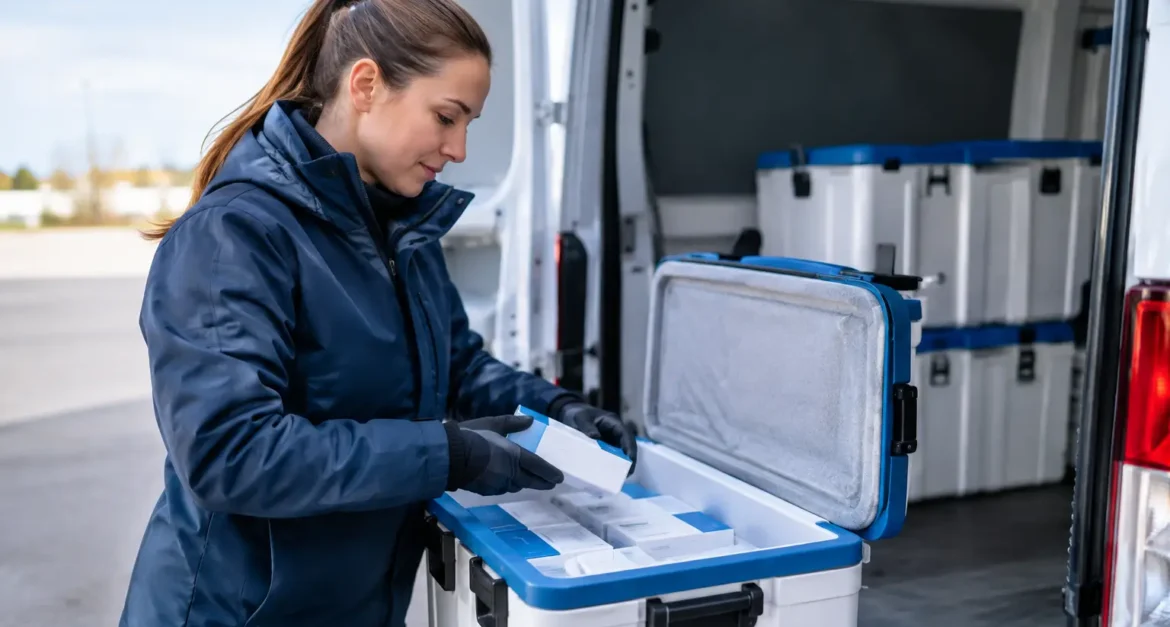
A medicine can arrive on time and still be unusable. If its approved temperature range has been breached in transit, the risk is not simply a rejected delivery. It may mean delayed treatment, lost stock, an investigation, and avoidable pressure on the supply chain. Pharmaceutical cold chain delivery is the controlled process that protects products from collection through to documented receipt.
For pharmacies, hospitals, laboratories, clinical trial teams and medical distributors, transport is not a final administrative step. It is a controlled part of product quality. The right delivery partner must maintain the agreed conditions, provide clear evidence of what happened during the journey, and respond quickly if the plan changes.
What pharmaceutical cold chain delivery must protect
Pharmaceutical products do not all travel under the same conditions. Some require chilled transport, often within a defined range such as 2°C to 8°C. Others may be frozen, controlled ambient, or held within a manufacturer-specific range. The correct requirement comes from the product’s approved storage and transport instructions, not from a generic definition of “refrigerated”.
The transport operation must protect more than the temperature displayed inside a vehicle. It must preserve product integrity across loading, vehicle movement, waiting time, delivery handover and any unexpected delay. That means considering the full route, the packaging used, the outside weather, the delivery window and the time the consignment may spend outside a controlled environment.
Temperature is only one control. Time, security, cleanliness, handling and traceability also matter. A high-value consignment left at an unsuitable reception point, or handed to an unauthorised person, can create a serious compliance and quality issue even where the temperature record appears acceptable.
Why standard courier transport is rarely enough
A conventional courier service is designed to move parcels efficiently. It may not be designed to protect temperature-sensitive medicines against exposure during collections, depot handling, route changes or missed delivery attempts. For pharmaceutical distribution, those gaps can be unacceptable.
Specialist pharmaceutical and medical transport uses planned controls rather than assumptions. Vehicles should be suitable for the required temperature range, pre-conditioned where necessary, and supported by calibrated monitoring equipment. Drivers need clear handling instructions, while operations teams need live location information and the ability to intervene before a delay becomes a product-risk event.
The required level of control depends on the product and route. A short, direct delivery of stable ambient medical stock may need a different solution from a same-day, chilled clinical trial shipment with a precise hospital handover. The principle is the same: match the transport plan to the product risk.
The cost of a temperature excursion
A temperature excursion is not automatically proof that a product has failed. Its effect must be assessed against the product’s stability data, the temperature reached and the duration of exposure. However, that assessment can require quarantine, quality review and extensive documentation.
The operational aim is therefore simple: prevent excursions where possible and make any issue visible immediately. Real-time monitoring gives a transport team the chance to investigate a warning, check vehicle performance, adjust the route or arrange contingency support while the consignment is still moving. A temperature report produced after delivery is useful evidence, but it cannot correct a problem that has already occurred.
The controls behind a dependable delivery
Reliable cold-chain delivery is built through disciplined preparation. Before collection, the operator should confirm the required temperature range, collection and delivery contacts, time window, packaging expectations, security instructions and any special handling requirements. Ambiguity at this stage is where many avoidable failures begin.
At collection, product condition and paperwork should be checked against the instruction. The consignment should move into the appropriate controlled vehicle promptly, with the temperature monitoring process active from the agreed point. Where a shipment is particularly sensitive, a direct vehicle and dedicated route may be the right choice because it reduces handovers and waiting time.
During transit, operations teams need full visibility of the vehicle location and temperature status. GPS tracking helps confirm progress against the planned route and delivery slot. Digital monitoring provides an auditable record of the conditions maintained. Together, these controls give supply chain teams evidence rather than reassurance alone.
The final handover is equally significant. Delivery should be made to the authorised recipient, within the agreed time window, with proof of delivery and the required transport records available. For temperature-sensitive medicines, an unattended doorstep drop or a vague signature is not a substitute for a controlled handover.
Choosing the right pharmaceutical cold chain delivery model
There is no single transport model that suits every pharmaceutical consignment. The best approach depends on product sensitivity, urgency, shipment size, delivery location and the level of documentation required.
A dedicated same-day vehicle is often appropriate for urgent medicines, clinical supplies, laboratory materials or high-value stock. It provides direct movement, fewer touchpoints and greater control over route changes. This is particularly valuable when a hospital, pharmacy or laboratory has a narrow receiving window.
Planned next-day delivery can be effective for regular routes where the service is designed around the product requirements and a reliable delivery slot. It may offer better cost efficiency for repeat distribution, but only if the planned network and handling model maintain the required controls from end to end.
Multi-drop pharmaceutical delivery requires additional discipline. Each stop introduces door openings, dwell time and a further handover. A suitable route plan, vehicle capacity, compartment control and clear delivery sequencing are essential. Multi-drop can be a practical option for regular pharmacy or healthcare distribution, but it should never compromise the most temperature-sensitive product on board.
For organisations with frequent or variable demand, dedicated day-rate vehicles can provide a flexible extension of the in-house fleet. This gives operations teams a controlled transport resource for urgent replenishment, inter-site transfers, product launches or seasonal pressure without committing to permanent vehicle ownership.
Documentation is part of product protection
In pharmaceutical logistics, evidence matters. A delivery may be physically complete, but without clear records it can be difficult to demonstrate that the product remained under control. Appropriate documentation supports quality teams, audits, customer assurance and investigation should an exception occur.
The exact records will depend on the product, customer procedures and applicable Good Distribution Practice expectations. In practice, businesses commonly need proof of collection and delivery, temperature data, vehicle and journey traceability, recipient details and documented escalation of any deviation. Records should be clear, accessible and retained in line with the organisation’s quality requirements.
A capable logistics provider will also understand the value of exception reporting. Delays, access issues, temperature alarms and failed delivery attempts should be communicated quickly, with the facts recorded. Hiding a problem creates more risk than reporting one early and managing it properly.
Questions to ask a cold-chain transport provider
Before appointing a provider, assess how they operate rather than relying on broad claims about refrigerated transport. Ask whether temperatures are monitored in real time or recorded only after the journey. Confirm how vehicles are maintained, how monitoring equipment is checked, and what happens if a vehicle fault or route disruption occurs.
It is also sensible to ask about driver training, out-of-hours support, escalation procedures and proof-of-delivery standards. If the service includes multi-drop distribution, establish how the provider manages door openings, route sequencing and deliveries that cannot be accepted on arrival.
Most importantly, discuss the product profile openly. A provider cannot design an appropriate service without knowing the required temperature range, acceptable delivery window, packaging format, consignment value and consequences of delay. The strongest transport plans are specific, documented and tested against real operational conditions.
A controlled partner when the stakes are high
MT Logistics Group provides pharmaceutical and medical cold-chain delivery across the UK for businesses that need temperature control, live visibility and reliable handovers. Refrigerated vehicles, real-time digital temperature monitoring and GPS tracking support full journey traceability, while responsive operations teams can coordinate time-critical collection and delivery requirements.
The objective is not merely to move a consignment from A to B. It is to protect the evidence, conditions and confidence that allow your product to be accepted when it arrives. When a medicine cannot tolerate uncertainty, build the transport plan around control before the vehicle is dispatched.