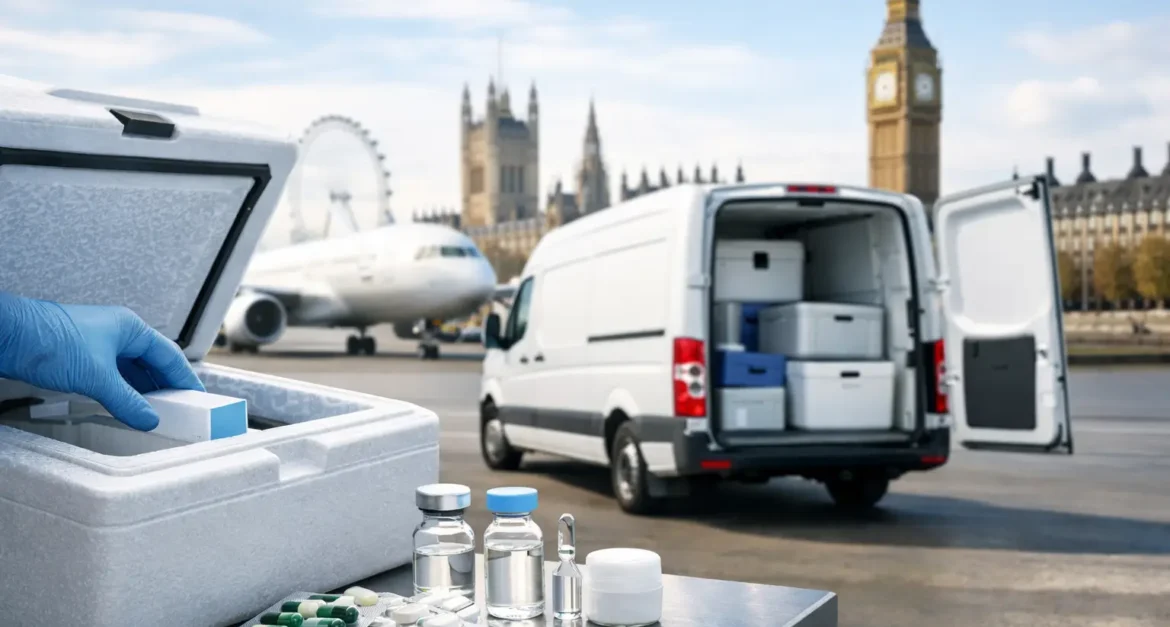
A pharmaceutical transport guide must start with a simple operational truth: a medicine can leave a compliant facility in perfect condition and still become unsuitable for use before it reaches the patient, pharmacy, hospital or research site. Temperature excursions, late handovers, incomplete records and poor vehicle preparation all create risk. Pharmaceutical distribution therefore needs more than a vehicle with refrigeration. It requires a controlled process that protects product integrity from collection through to proof of delivery.
For UK businesses moving medicines, vaccines, clinical-trial materials, diagnostic products or temperature-sensitive medical supplies, the right transport plan provides visibility, accountability and peace of mind when delivery windows are tight.
What pharmaceutical transport needs to control
Pharmaceutical products do not all have the same handling requirements. A refrigerated medicinal product may need to remain within a defined chilled range, while another product may be stored at controlled ambient conditions. Some consignments need frozen transport, and others require protection from short-term exposure to excessive heat or cold rather than active refrigeration throughout the journey.
The required temperature range, journey duration and product stability profile should determine the transport solution. Using a generic courier because a consignment is small can be a costly mistake if that carrier cannot maintain the required conditions or provide usable evidence of what happened in transit.
A controlled service should establish the product specification before collection. This includes the required temperature range, whether the load needs active temperature control, collection and delivery time windows, packaging instructions, security needs, named contacts and escalation procedures. Where a load contains different product types, a multi-temperature solution may be necessary. It depends on whether products can safely travel together and whether each compartment can maintain its own validated conditions.
Build the transport plan before the vehicle arrives
Good pharmaceutical transport is planned before the consignment is loaded. The collection team needs clear information, the vehicle needs to be suitable and pre-conditioned, and the receiving location needs to be ready to accept the goods. A delayed handover can compromise a tightly controlled journey even when the vehicle itself performs correctly.
Confirm the product and route risk
Start with the product’s approved storage and transport requirements, not an assumption based on its category. Confirm whether the stated range applies during the full journey, whether temporary excursions are permitted, and who has authority to assess an excursion if one occurs.
Then assess route risk. A direct same-day delivery to a hospital has different exposure points from a multi-drop pharmacy route. Consider collection queues, traffic restrictions, delivery booking slots, driver-hours requirements, site access, overnight stops and the availability of a suitable contingency vehicle. The fastest route is not always the most dependable route if it introduces avoidable delays or poor access conditions.
Select suitable packaging and vehicle control
Packaging and temperature-controlled transport work together. Insulated passive packaging may be appropriate for a short, validated journey, but it is not a substitute for active vehicle control where the product, distance or ambient conditions demand it. Equally, a refrigerated vehicle does not remove the need for correct packing, secure load placement and protection during loading and unloading.
The vehicle should be clean, maintained and capable of holding the specified range under expected operating conditions. It should be pre-cooled or pre-heated where required before loading. Load doors should not remain open longer than necessary, and the product must be positioned to allow air circulation rather than placed against evaporators or in areas prone to temperature variation.
Monitoring turns control into evidence
Temperature control without records is difficult to defend. Real-time digital monitoring gives operations teams visibility during the journey, while calibrated sensors and retained data create an auditable account of transport conditions.
For each movement, agree what will be monitored, where sensors will be positioned, how frequently readings are captured and who receives alerts. A vehicle air-temperature reading may not always represent the temperature experienced by the product, particularly for high-value or highly sensitive consignments. The monitoring approach should match the risk level and product requirement.
GPS tracking adds another layer of control. It helps confirm vehicle location, route progress and arrival times, allowing teams to intervene early if a delay develops. For urgent pharmaceutical deliveries, live visibility supports faster decisions: notify the receiving site, redirect the vehicle, arrange a contingency collection or prepare an alternative delivery slot.
Have an excursion process that works under pressure
No operation should rely on the hope that an exception will not happen. A practical deviation process sets out what the driver, transport controller and customer contact must do if a temperature alarm, vehicle fault, road closure or missed delivery occurs.
The first priority is to protect the consignment. This may mean checking the vehicle set point, confirming doors are secure, moving the product to a suitable contingency vehicle or returning it to an approved holding location. The second priority is to preserve accurate information. Record the timing, readings, actions taken and chain of communication. Product disposition must be decided by the appropriate quality authority, not by the transport provider alone.
A calm, documented response matters. It prevents well-intended but unauthorised decisions and gives the customer the evidence needed to assess the event properly.
Protect chain of custody at every handover
Pharmaceutical transport is also a security and traceability discipline. Each handover should identify who released the consignment, who accepted responsibility and who received it at the final destination. Delivery to an unattended reception, an unverified person or an unsuitable storage area can undermine an otherwise well-managed journey.
Collection records should confirm consignment condition, quantity, packaging integrity and relevant temperature status. At delivery, obtain a clear proof of delivery from an authorised recipient, noting the time, location and any visible issue. For controlled, high-value or clinical-trial materials, additional identity checks and tamper-evident measures may be appropriate.
Security controls should reflect the product and route. A dedicated vehicle reduces the risk of unplanned handling and competing delivery priorities. For sensitive or urgent consignments, direct transport with defined handovers is often preferable to a shared network. The trade-off is cost, but the reduced exposure, faster transit and clearer accountability can justify it where product value or patient impact is high.
Choose a transport partner on evidence, not promises
When assessing a pharmaceutical carrier, ask operational questions. Can it provide a vehicle appropriate to the required temperature range? How are temperature systems monitored and maintained? What records are available after delivery? What happens if a vehicle develops a fault? Can the team manage booked hospital deliveries, urgent collections and out-of-hours escalation?
A dependable partner should answer clearly and specifically. Look for proven temperature-controlled capability, trained personnel, real-time monitoring, GPS visibility, documented procedures and a practical contingency plan. Generic assurances are not enough when a consignment’s quality depends on exact conditions.
MT Logistics Group supports pharmaceutical and medical movements with dedicated temperature-controlled vehicles, digital monitoring and full journey traceability. For businesses with urgent or scheduled distribution requirements, that combination creates control without losing the responsiveness needed in live operations.
Keep records ready for review
Transport documentation should be organised so it can be retrieved quickly for a customer query, quality review or audit. Retain the booking instruction, vehicle and temperature records, collection and delivery confirmations, route information, deviation reports where applicable, and communication relating to exceptions.
Records should be legible, attributable and consistent with the actual journey. A complete file does more than demonstrate compliance. It helps identify recurring issues such as a delivery point with long waiting times, a route that regularly causes excursions or a packaging method that needs reassessment.
A practical standard for every shipment
The strongest pharmaceutical transport operations treat every journey as a controlled chain rather than a series of separate tasks. Product requirements inform the vehicle choice. Vehicle preparation supports the packaging. Monitoring provides live control and evidence. Trained people manage handovers and respond to exceptions without delay.
Before the next consignment leaves site, test the plan against one question: if a quality team reviewed this journey from collection to delivery, would the records show that the product was protected at every point? If the answer is not a clear yes, strengthen the process before the vehicle is loaded.