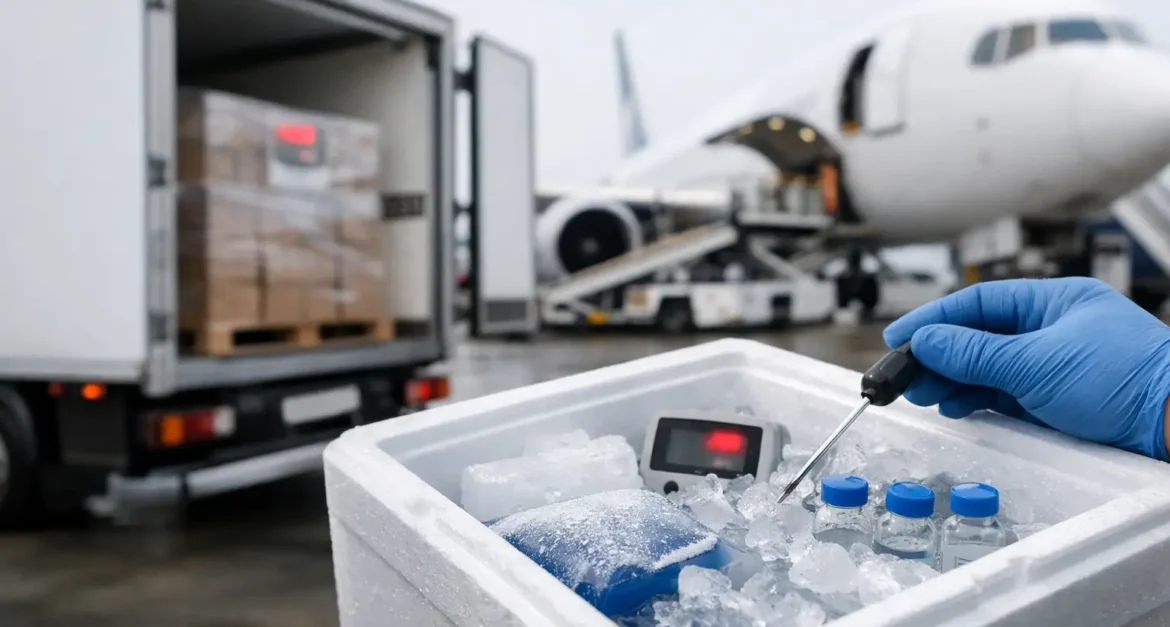
A chilled consignment can leave site at the correct setpoint and still arrive outside specification. Often, the problem is not one dramatic breakdown. It is a series of small control failures: an open door during a delayed collection, a poorly pre-cooled load space, an incorrect probe placement, or a driver without clear escalation instructions.
For businesses moving food, pharmaceuticals, medical products and other sensitive goods, understanding what causes cold chain failures is the first step towards preventing costly waste, rejected deliveries, compliance exposure and damaged customer confidence. Cold-chain integrity depends on every handover, vehicle, process and decision performing as intended.
What causes cold chain failures?
A cold chain fails when a product is exposed to conditions outside its validated temperature range, or when there is insufficient evidence to prove it remained within range. Temperature is central, but it is not the only factor. Time, handling, loading practices, vehicle condition, route management and data quality all affect whether a consignment remains safe, compliant and fit for use.
The most serious failures tend to occur at transition points. Collection, loading, multi-drop delivery, cross-docking and final handover all introduce risk because product leaves one controlled environment and enters another. A refrigerated vehicle cannot compensate for poor preparation at either end of the journey.
Inadequate pre-cooling
A common error is loading temperature-sensitive goods into a vehicle that has not reached its required operating temperature. Refrigeration units are designed to maintain a product’s condition, not necessarily to pull down the temperature of a warm load quickly enough to protect it.
This matters particularly for frozen goods, fresh produce and pharmaceutical consignments with narrow tolerances. If the load space, insulated packaging or vehicle body is warm at collection, product may begin gaining heat before the journey has properly started. The temperature record may show a later recovery, but that does not remove the exposure that has already occurred.
Pre-cooling must be planned against the required setpoint, ambient conditions, vehicle size and loading time. The correct question is not whether the unit is running. It is whether the vehicle and product environment are demonstrably ready to receive the load.
Equipment faults and poor maintenance
Refrigeration failures can be obvious, such as a unit shutting down, but gradual faults are just as dangerous. A worn door seal, damaged curtain, blocked airflow, low refrigerant level, inaccurate sensor or weak battery connection can compromise performance without triggering an immediate alarm.
Preventive maintenance reduces this risk, but maintenance alone is not enough. Operators need pre-departure checks, verified temperature readings and a defined response when an alarm occurs. If a warning is ignored while a driver continues towards a delivery point, a manageable issue can become a product-loss event.
There is also a trade-off between operational speed and equipment assurance. Sending a vehicle out quickly after a late return may appear efficient, yet skipping checks can expose the entire next load. For time-critical transport, contingency capacity and disciplined inspection routines are more valuable than relying on luck.
Incorrect loading and restricted airflow
Even a fully functioning refrigerated vehicle can struggle if it is loaded incorrectly. Pallets stacked too tightly against the evaporator, goods placed above load lines, blocked air channels and mixed products with incompatible requirements can create warm or cold spots inside the load space.
Air must circulate around and through the consignment as the vehicle was designed to operate. A load that looks secure may still be thermally unsafe. This is especially relevant in multi-drop work, where remaining stock shifts over time and empty spaces can alter airflow.
Product temperature should also be checked at handover, not assumed from the vehicle display. The vehicle air temperature and the temperature at the core of a product are related, but they are not the same measurement. For certain goods, validated product probes, packaging controls and documented acceptance criteria are necessary.
Door openings, delayed stops and poor site discipline
Every door opening introduces warmer ambient air. On a short, single-drop journey, this may have limited effect. On a multi-drop route with repeated deliveries, long waiting periods or busy loading bays, the cumulative effect can be significant.
Delays are not always caused by the transport provider. A site may have no available bay, paperwork may be incomplete, or a receiving team may not be ready. Yet the product remains at risk while the vehicle waits. Clear booked slots, rapid unloading procedures and agreed escalation contacts reduce unnecessary exposure.
Drivers also need authority to protect the load. If a delivery cannot be accepted promptly, they should know when to close doors, record the delay, contact control and move to a contingency plan. Leaving a vehicle open while a problem is resolved is not a service solution.
Poor route planning and unrealistic schedules
Cold-chain transport is time-sensitive, not simply temperature-controlled. A route built around ideal traffic conditions can fail when roadworks, motorway incidents, vehicle queues or a late collection add pressure. Drivers may then rush loading, shorten checks or keep doors open to recover time at delivery points.
Route planning should account for journey time, service windows, fuel requirements, rest breaks, known congestion and the number of stops. It should also distinguish between products. A frozen retail delivery, a chilled food load and a clinical shipment may each require different tolerance levels, priority rules and recovery actions.
For urgent work, the fastest route is not always the safest operational choice. A dedicated vehicle, direct delivery and live tracking may be more appropriate than attempting to fit a critical consignment into a complex shared route.
Weak monitoring, missing records and slow escalation
A consignment can remain physically within range but still become commercially unusable if records are incomplete. In regulated sectors, proof of control is part of the service. Missing temperature data, unexplained gaps in a journey record or no evidence of delivery condition can lead to a rejection even where no deviation is confirmed.
Real-time digital monitoring provides earlier warning than a report reviewed after delivery. However, data only has value when someone is watching it and knows what to do next. Alarm thresholds, escalation contacts, decision authority and corrective actions should be agreed before a vehicle departs.
A useful incident process records the time and duration of a deviation, the measured temperatures, likely cause, product status, actions taken and customer notification. Whether the product can continue depends on its specification, the nature of the exposure and the customer’s quality procedure. It should never be decided by assumption.
Preventing cold chain failures through control at every handover
Reliable cold-chain performance is built through preparation and visibility. Start with a clear transport brief that states the required range, product condition at collection, packaging needs, delivery deadline, monitoring requirement and any product-specific handling instructions. Ambiguous instructions create avoidable risk.
At collection, verify product condition, vehicle setpoint and load-space readiness before loading begins. During transit, use monitored vehicles with live location and temperature visibility, then act promptly when an exception occurs. At delivery, record the handover and retain the temperature evidence needed by the customer.
For mixed loads, multi-temperature capability must be matched to the actual product requirements. Separating chilled, frozen and ambient goods is not just a capacity decision. It is a control decision involving compartment performance, loading sequence, delivery order and access discipline.
MT Logistics Group applies this approach through temperature-controlled vehicles, real-time monitoring, GPS tracking and full journey traceability. The objective is simple: identify risk early, keep decision-makers informed and protect the condition of the goods from collection through to proof of delivery.
The right response when a deviation occurs
No operation can eliminate every disruption. A refrigeration alarm, road closure or site delay can still happen. What separates a controlled operation from a cold-chain failure is the speed and quality of the response.
The immediate priority is to protect the load: minimise door openings, check the vehicle and temperature data, notify the relevant control team and assess whether the journey should continue, divert, return or transfer to contingency equipment. The customer should receive clear information, not a vague update after the event.
Afterwards, investigate the root cause. Was the setpoint wrong? Was the vehicle insufficiently pre-cooled? Did a delivery site create a prolonged delay? Did an alarm fail to reach the right person? Corrective action should address the process, not merely the individual incident.
Cold-chain reliability is earned in the details. When preparation, monitoring and escalation are treated as part of every delivery rather than extra administration, sensitive products arrive with their quality, compliance and value protected.