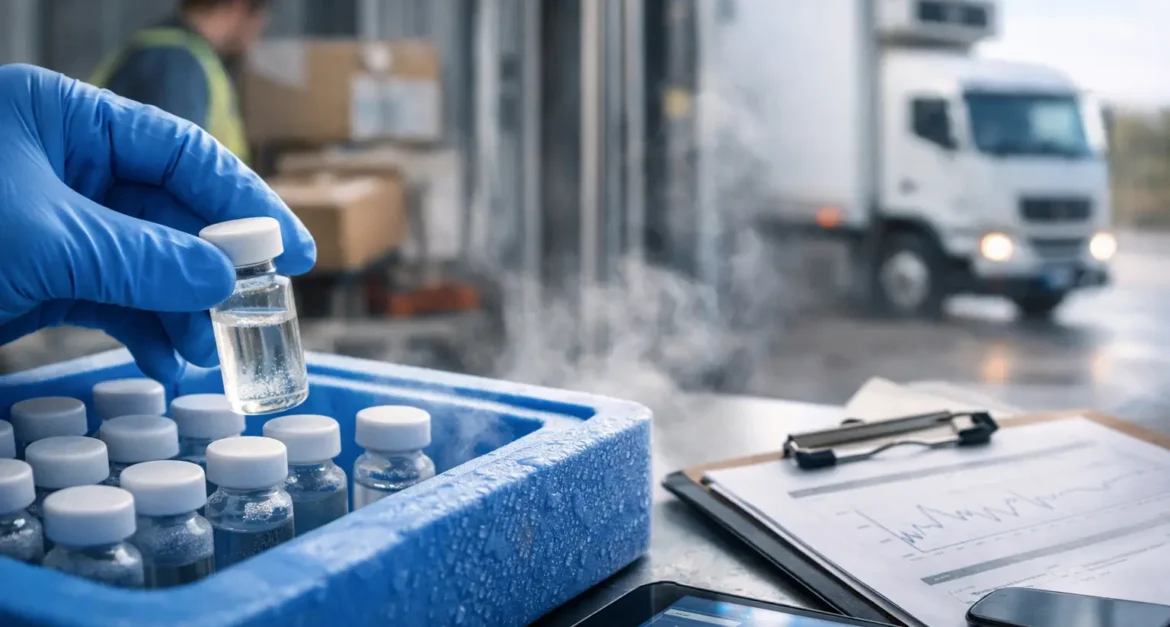
A temperature alert at 06:40 can become a full commercial recall before the first delivery window closes. This cold chain recall case study shows why the response depends on more than a refrigerated vehicle: it requires accurate consignment data, real-time temperature visibility, disciplined communication and a carrier able to act immediately.
The scenario below is representative rather than a record of one customer incident. It reflects the operational pressures faced by food distributors, pharmacies, laboratories and retail supply chains when product integrity is called into question.
The incident: a small deviation with serious consequences
A UK chilled food distributor had loaded mixed dairy and prepared-food consignments for a multi-drop route serving independent retailers and hospitality customers. The product specification required transport between 0°C and 5°C. Each pallet was labelled, segregated by customer and scanned at collection.
Forty minutes after departure, the vehicle’s digital monitoring system identified a rising return-air temperature. The vehicle was still operating, but the readings had moved outside the agreed range. The driver received an immediate instruction to stop at a safe location while the control team reviewed the live data.
This is the point at which many businesses lose valuable time. A temperature reading outside specification does not automatically mean every item is unsafe or unsaleable. Equally, it cannot be dismissed as a minor fault. Product temperature, exposure duration, load position, packaging performance and the customer’s quality procedures all need to be assessed. The correct approach is to contain the risk first, then establish the facts.
The first hour: contain, verify and protect
The initial objective was simple: prevent potentially affected stock from reaching customers. The transport team placed the consignment on hold, suspended the planned delivery schedule and recorded the incident time. No pallets were released without authorisation from the distributor’s quality team.
A replacement temperature-controlled vehicle was dispatched. At the roadside, the driver maintained vehicle security, kept doors closed and followed the agreed escalation procedure. The load was transferred under controlled conditions, with pallet counts, seal status and transfer times documented.
The response was effective because the operator could answer four questions without delay:
- Which vehicle carried the affected products?
- Which pallets and batches were on board?
- When did the temperature begin to deviate?
- Had any deliveries already been completed?
In this case, no stock had been delivered. That fact significantly reduced the recall scope, but it was confirmed through GPS records, proof-of-collection data and route status rather than assumption.
Why a route-wide recall is not always necessary
A common mistake is to treat every temperature issue as an all-or-nothing event. Recalling the entire load may be the right decision where exposure cannot be verified, where products have mixed storage requirements or where the customer’s procedures demand it. However, an unnecessarily broad recall creates avoidable waste, cost and disruption.
Conversely, narrowing the scope without reliable evidence puts consumers, patients and brand reputation at risk. The decision must be based on traceable records and the product owner’s quality assessment, not on delivery pressure or a driver’s judgement alone.
Establishing the true product exposure
The refrigerated vehicle’s air-temperature record was reviewed alongside loading and transfer information. Air temperature matters, but it is not the same as product-core temperature. A brief rise in air temperature may have limited impact on a well-packed pallet, while prolonged exposure can compromise sensitive goods even when the vehicle later returns to range.
The distributor’s quality team reviewed the time-temperature profile against product specifications. They considered the duration of the deviation, the maximum recorded temperature, pallet placement, insulation and whether chilled and ambient products had been separated correctly. The team also inspected the vehicle after the transfer to identify the technical cause.
The cause was traced to a refrigeration unit fault that reduced cooling performance under load. The vehicle was removed from service pending repair and validation. That decision protected future consignments as well as the stock involved in the incident.
For pharmaceutical and medical distribution, this stage is often more stringent. Manufacturers may require validated data loggers, approved excursion limits, batch-level documentation and formal disposition by a responsible quality representative. Food products may follow different rules, but the principle is the same: do not guess. Maintain a complete evidence trail.
Traceability turns a disruption into a controlled response
Because the distributor had scanned each pallet at loading, the team could create an affected-stock report within minutes. It showed product description, batch number, quantity, customer allocation and current location. The replacement vehicle was then directed to return the affected load to the distributor’s controlled holding area rather than continue with deliveries.
The goods were clearly quarantined on arrival. They were physically separated from released stock, labelled as on hold and entered into the customer’s quality system for assessment. This matters. A pallet that remains visible in a warehouse but is not formally quarantined can be picked, dispatched or mixed with approved stock by mistake.
The distributor notified the relevant customers that deliveries would be delayed while product quality was assessed. The message was concise and factual. It explained that the stock was being held as a precaution, confirmed that replacement arrangements were being made and gave a revised delivery position. There was no speculation about cause or product safety before the quality decision had been made.
This communication protected customer confidence. Retailers and hospitality operators can plan around a delayed delivery when they receive clear notice. They cannot plan around uncertainty, late updates or a vehicle that arrives with stock of questionable status.
The recovery plan: keep the supply chain moving
Following assessment, some products were released because the available evidence showed they remained within acceptable exposure limits. Other stock was rejected and isolated for disposal or supplier instruction. The decision sat with the product owner’s quality process, supported by the transport records.
Replacement stock was prioritised for customers facing the greatest operational impact. A hospital catering site, for example, may require an earlier recovery delivery than a customer with reserve chilled inventory. The route plan was rebuilt around delivery windows, stock availability and vehicle capacity.
This is where dedicated refrigerated transport adds value. A specialist provider can deploy a suitable replacement vehicle, maintain required temperature settings and provide live tracking while the recovery is under way. For mixed loads, the vehicle must also support the relevant chilled, frozen or ambient zones. A fast response that places frozen stock in an unsuitable compartment is not a recovery plan.
MT Logistics Group supports this type of time-critical work through monitored temperature-controlled vehicles, GPS visibility and documented handovers. The focus is not simply on moving replacement goods quickly. It is on restoring continuity without introducing a second compliance risk.
What the case study reveals about recall readiness
The incident was contained because preparation had already been built into the operation. The distributor did not need to decide how to find the affected pallets, who could authorise a hold or where the replacement vehicle would come from while the temperature continued to rise.
A workable cold-chain recall plan should define escalation contacts across transport, quality, warehouse and customer service teams. It should state who can stop a delivery, who can release or reject product, and how out-of-hours incidents are managed. It also needs a practical method for quarantine, a current customer contact list and clear procedures for recording every handover.
Data quality deserves equal attention. Temperature records must be accessible, time-stamped and linked to the correct vehicle and journey. GPS should show actual vehicle location and route progress. Pallet or consignment scans should make it possible to identify affected customers without manual spreadsheet searches. These records are not administrative extras. During a recall, they are the basis for controlled decisions.
There is a trade-off to manage. More monitoring points, more scans and more documented checks can add time to daily operations. Yet the right controls reduce the far greater cost of wide-scale product withdrawal, failed audits, wasted stock and damaged customer relationships. The answer is not paperwork for its own sake. It is proportionate control that matches the value, sensitivity and regulatory requirements of the products being moved.
Test the plan before an incident tests it for you
A recall process should be rehearsed, particularly where a business handles high-value pharmaceuticals, clinical materials, fresh produce or high-volume multi-drop distribution. Run a timed exercise using a realistic question: a vehicle has recorded an excursion midway through a route, and two drops may already have been completed. Can the team identify the vehicle, batches, customers, delivery status and relevant temperature data within an hour?
If the answer depends on one person’s memory, a call to a driver who is unavailable or records held across several systems, the process needs work. A dependable cold chain is built on repeatable controls, not individual heroics.
When a temperature deviation occurs, speed matters. Evidence matters more. The strongest response is the one that stops uncertain stock, protects approved stock, informs the right people and gives the supply chain a clear route back to normal operation.