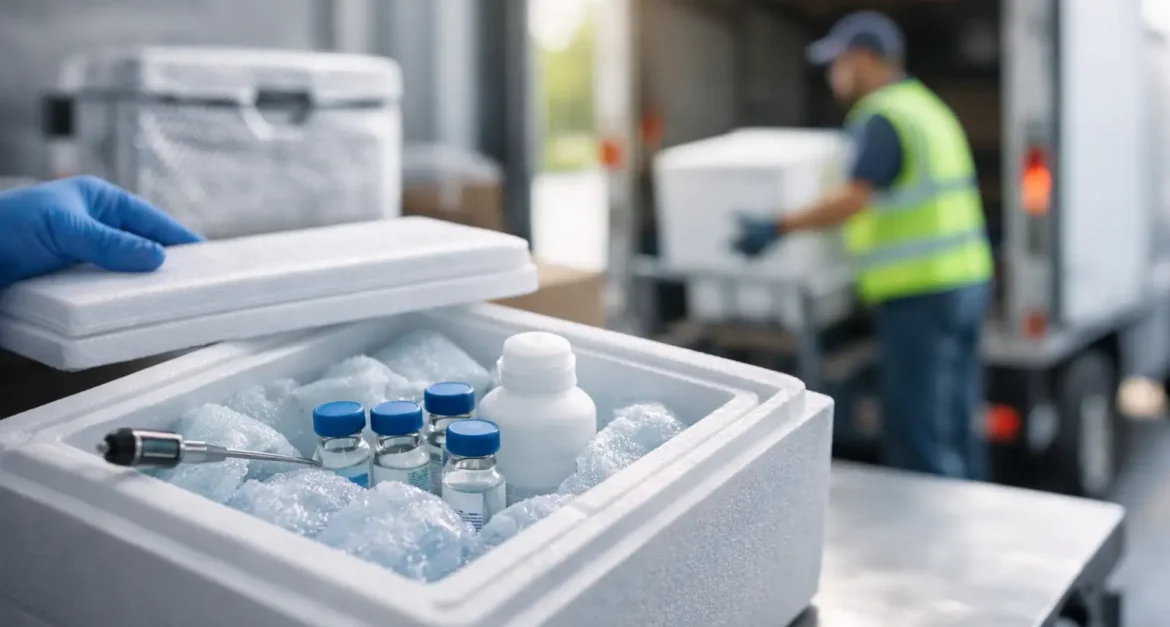
A chilled pharmaceutical consignment can look routine until a delayed collection, open vehicle door or unplanned overnight hold puts the product outside its approved conditions. Knowing how to ship chilled pharmaceuticals means treating temperature, time, security and documentation as one controlled operation – not as separate tasks.
For many products, the acceptable range may be 2°C to 8°C, but that is not a default instruction for every medicine. The product label, marketing authorisation, stability data and quality agreement determine what must be maintained, recorded and escalated. The transport plan should follow those requirements from collection through to final proof of delivery.
Start with the product’s approved transport profile
Before booking a vehicle or selecting packaging, establish the shipment specification. Confirm the required temperature range, permitted exposure limits, journey duration, delivery deadline, handling restrictions and whether the consignment needs protection from light, shock or moisture.
This information should come from the product owner, responsible person or quality team. A chilled product may tolerate short, defined excursions under stability data, while another may require immediate quarantine after any deviation. Assuming that all refrigerated medicines can be handled in the same way creates avoidable risk.
Also confirm the product’s status. Commercial medicines, clinical trial materials, investigational medicinal products, samples and medical products can each have different release, security and documentation requirements. Where Good Distribution Practice applies, the transport arrangement must support the quality system rather than sit outside it.
Choose a validated temperature-control method
The right solution depends on the route, consignment size, ambient conditions, delivery windows and risk profile. For a direct, time-critical UK delivery, a dedicated refrigerated vehicle with active temperature control is often the clearest option. It reduces handling points, limits dwell time and gives the consignor greater control over collection and delivery.
For longer or more complex journeys, qualified passive packaging may be suitable, provided it has been tested for the expected duration and seasonal temperature conditions. Passive systems can work well, but only when pack-out instructions are followed exactly. Incorrect conditioning of gel packs, poor loading practice or an underestimated delay can compromise their performance.
Do not select packaging solely by its stated temperature range. Ask whether it is qualified for the actual lane, anticipated external temperatures, product volume and delivery duration. A package that performs for 24 hours in mild weather may not protect a consignment held in a hot depot or travelling through winter conditions.
Active refrigerated transport also requires proper control. The vehicle should be suitable for pharmaceutical work, pre-conditioned where required, maintained and clean. The load space must reach and hold the defined set point before goods are introduced. A chilled vehicle is not automatically compliant simply because it feels cold.
Avoid unnecessary mixed loads
Where possible, pharmaceuticals should travel on a dedicated service. Shared capacity can be appropriate only where segregation, security, temperature compatibility, handling controls and delivery timing have been properly assessed.
Mixed-load operations introduce more door openings, more stops and more potential for loading errors. If a multi-temperature vehicle is used, each compartment must be controlled and monitored independently, with the correct product allocated to the correct zone.
Plan the route around temperature and time risk
A route plan should account for more than mileage. Collection readiness, site access, loading constraints, driver hours, traffic patterns, delivery booking times, bank holidays and contingency locations all affect the real journey duration.
For time-sensitive medicines, direct collection-to-delivery movement is usually preferable. Every cross-dock, depot hold or transfer adds a handover and an opportunity for delay. If a network movement is necessary, define who is responsible at each stage and how the product remains protected during loading, storage and onward dispatch.
Build a practical contingency plan before the vehicle leaves. This should cover vehicle breakdown, traffic disruption, refused delivery, recipient closure, temperature alarm, damaged packaging and contact failure. The correct response may be to move to an approved alternative delivery point, return the consignment, or hold it in a qualified facility while the quality team decides what happens next.
The key point is speed with control. A driver should never have to guess whether to leave temperature-sensitive medicines unattended, take them back to a depot or wait at an unconfirmed address.
Monitor temperature throughout the journey
Temperature monitoring provides evidence that conditions were maintained. It also allows a rapid response when conditions change. For chilled pharmaceutical transport, use calibrated monitoring equipment that is appropriate to the shipment and capable of producing records your quality team can review.
Real-time digital monitoring is particularly valuable for high-value, urgent or deviation-sensitive products. It gives the transport team visibility during the journey rather than only revealing a problem when the shipment arrives. GPS tracking adds another layer of assurance by showing where the vehicle is, whether the planned route is being followed and how long it has been stationary.
Decide in advance how alarms will be managed. Define the alarm thresholds, escalation contacts, expected response times and decision authority. A low-temperature alarm, for example, may require the driver to check airflow and door security immediately, while a sustained excursion may trigger instructions from the product owner’s quality representative.
Data alone is not enough. Records must be legible, retained and linked clearly to the consignment. If a recipient or regulator asks for evidence, you should be able to retrieve the temperature history, collection time, delivery time, vehicle details and proof of handover without delay.
Control collection, loading and handover
The cold chain is often most vulnerable while goods are outside the vehicle. Arrange collection only when the product is released, packed, labelled and ready to load. Avoid leaving cartons on a loading bay while paperwork is completed or a vehicle is being prepared.
At collection, check the consignment reference, number of packages, package condition, labels and special handling instructions. Record any visible damage before accepting the goods. The sender should provide emergency contacts and clear instructions for any deviation or delivery failure.
Load chilled pharmaceuticals in a way that protects airflow and prevents crushing. Do not block evaporators or vents, place cartons against areas likely to freeze, or stack beyond the packaging specification. The vehicle should remain closed as much as possible during loading, particularly in warm weather or at busy sites.
At delivery, confirm the recipient is authorised to receive the consignment. Capture the delivery time, recipient name, signature or digital proof of delivery, and any comments about package condition. If the site cannot accept the goods, follow the agreed contingency plan rather than leaving the shipment in an uncontrolled reception area.
Keep documentation ready for review
A compliant shipment needs a traceable record, not just a successful delivery status. The exact document set depends on the product and customer agreement, but it commonly includes transport instructions, consignment details, temperature records, calibration status, cleaning and maintenance evidence, driver training records, deviation reports and proof of delivery.
For regular routes, a written quality agreement helps prevent gaps between the pharmaceutical company and logistics provider. It should establish responsibilities for temperature control, monitoring, security, subcontracting, deviations, complaints, recalls, data retention and escalation. This is especially valuable where several teams handle the same lane.
Training matters as much as paperwork. Drivers and operations staff need to understand why a door left open, a misplaced carton or a missed delivery window can affect product quality. They should know the required action, who to call and what to record when something does not go to plan.
Review each lane, not just each shipment
Cold-chain performance improves when it is measured. Review temperature trends, late deliveries, alarm events, failed delivery attempts, claims and route delays. A recurring issue at one collection point or one delivery site may be solved by changing the booking time, vehicle type, pack-out, loading procedure or route sequence.
Seasonality also deserves attention. A lane that performs well in March may require different controls during a summer heatwave or winter cold spell. Requalification or seasonal risk assessment may be needed where external conditions materially change the transport challenge.
MT Logistics Group supports chilled pharmaceutical deliveries with dedicated temperature-controlled vehicles, real-time visibility and traceable handovers across the UK. The right partner should be able to explain exactly how your product will be protected, what happens if the plan changes, and where accountability sits at every stage.
When the product, route and risk controls are agreed before collection, chilled pharmaceutical transport becomes a managed quality process rather than a last-minute delivery task.