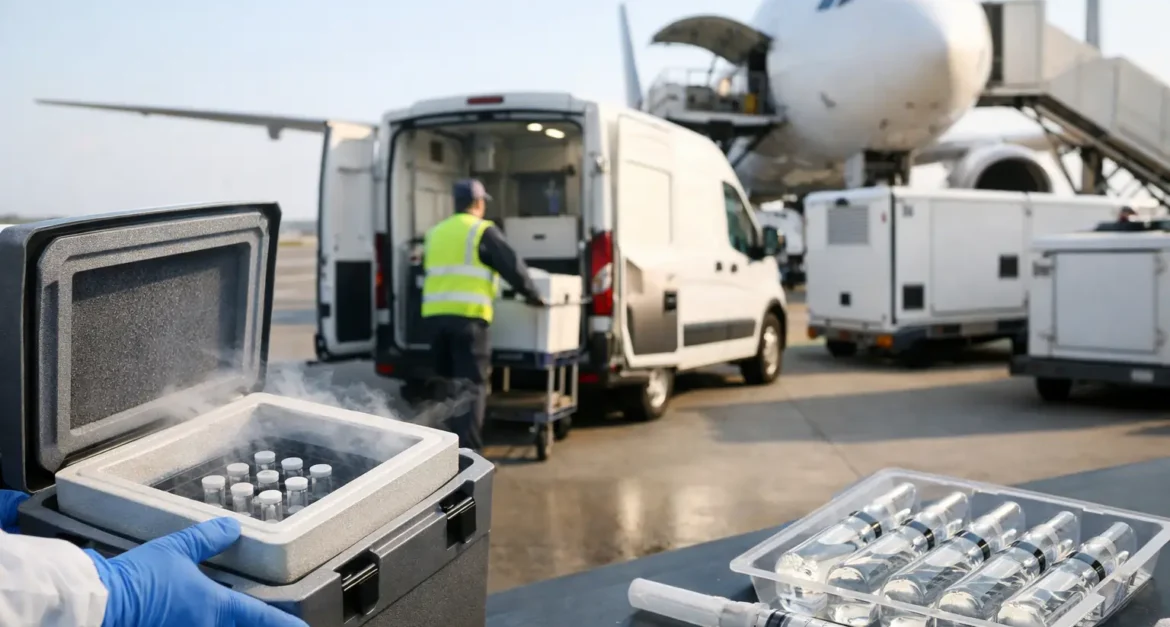
A pharmacy waiting on refrigerated medicines, a laboratory receiving diagnostic samples, and a clinical trial site expecting investigational products have one thing in common: a late or poorly controlled delivery can quickly become a patient-safety and compliance issue. So, who needs GDP transport? Any organisation moving medicinal products or pharmaceutical materials that must remain secure, traceable and within defined storage conditions during distribution.
GDP stands for Good Distribution Practice. It sets the standard for maintaining the quality and integrity of medicinal products throughout the supply chain. It is not simply a requirement for goods that travel in a refrigerated vehicle. It applies to the processes, people, records, security measures and controls surrounding each movement.
Who needs GDP transport in the UK?
GDP transport is relevant wherever a business handles medicines or pharmaceutical products after manufacture and before supply to the patient or end user. The requirement may sit directly with a wholesale distribution authorisation holder, but responsibility does not disappear when goods are handed to a transport partner.
Pharmaceutical wholesalers and distributors are the most obvious users. They need to move prescription medicines, over-the-counter products and controlled medicines to pharmacies, hospitals, dispensing doctors and healthcare providers. These deliveries can involve ambient, chilled or frozen conditions, along with strict timed delivery windows and secure handover requirements.
Pharmacies also need GDP-aware transport when moving stock between branches, receiving urgent replenishment, supplying care homes, or arranging deliveries to patients where appropriate. A vehicle arriving promptly is only part of the job. The product must be protected from temperature excursions, damage, loss and unauthorised access from collection through to proof of delivery.
Hospitals, NHS trusts and private healthcare providers may require GDP transport for medicines, specialist therapies, vaccines and critical treatment stock. Some consignments are routine, while others are urgent. A same-day collection may be needed because a ward has an immediate clinical requirement, a site has experienced a stock shortage, or a temperature-sensitive product cannot wait for a standard distribution run.
Laboratories, biotech firms and clinical research organisations often have equally demanding requirements. They may move clinical trial medicines, diagnostic materials, reference standards or pharmaceutical samples between manufacturers, depots, research sites and laboratories. The right transport specification depends on the product and route, but chain of custody, condition monitoring and documented handling remain central.
Manufacturers and marketing authorisation holders also need GDP-compliant distribution arrangements when transferring products from production facilities to wholesalers, distribution centres or healthcare customers. Even when a third-party logistics provider carries the load, the manufacturer must be satisfied that the chosen service supports the required product conditions.
GDP transport is not only about refrigerated medicines
A common misconception is that GDP only concerns cold-chain products. Chilled medicines, vaccines and biologics clearly need controlled transport, often within a narrow range such as 2°C to 8°C. However, many pharmaceutical products are labelled for controlled ambient storage and still require protection from excessive heat, cold, humidity, contamination and direct sunlight.
This is why an ordinary parcel service or general freight network may not be suitable. A medicine labelled for ambient storage can still be compromised if it is left in an unmonitored depot, loaded into an unsuitable vehicle or delayed over a weekend. GDP transport considers the real conditions a product encounters, not just the temperature shown on its label.
The required solution should be based on a risk assessment. Product stability data, route duration, seasonal weather, packaging performance, delivery location and the consequences of failure all matter. A short local delivery of low-risk ambient stock may need a different control level from an urgent refrigerated consignment travelling nationwide.
The operational controls GDP transport requires
Reliable GDP transport is built on more than a cold vehicle. The process must give the sender evidence that products were protected and that any issue can be investigated properly.
Temperature-controlled vehicles should be suitable for the consignment, maintained appropriately and monitored throughout the journey where required. Real-time digital temperature monitoring provides practical control during transit. It gives the transport team visibility of conditions and supports a quick response if a deviation or equipment concern arises.
Traceability is equally important. Collection time, vehicle allocation, route progress, delivery time and proof of handover should be available and accurately recorded. For high-value or sensitive medicines, transport providers may also need enhanced security arrangements, including secure vehicles, controlled access and clear escalation procedures.
Staff competence is another essential control. Drivers and operations teams need to understand what to do if they encounter traffic disruption, vehicle breakdown, a refused delivery, damaged packaging or an alarm. Products cannot be left unattended while a problem is resolved. A clear contingency plan protects the consignment and prevents uncertainty from becoming a compliance failure.
For many businesses, qualification and documentation will form part of supplier approval. This may include vehicle and equipment records, temperature-monitoring information, maintenance controls, training evidence, deviation procedures and agreed service specifications. The exact level of documentation depends on the product, risk profile and quality system, but the principle is consistent: a transport partner must be able to demonstrate control, not merely promise it.
When a standard courier is not enough
A standard courier can be suitable for general commercial goods, but pharmaceutical distribution presents different risks. Network models commonly involve multiple handling points, variable dwell times and limited visibility once a consignment enters the wider system. That can be incompatible with a medicine requiring direct, secure and time-defined transport.
GDP transport is usually the stronger choice when the delivery involves controlled temperature conditions, a strict delivery appointment, valuable stock, patient-critical medication, sensitive documentation or a requirement for clear chain-of-custody records. It is also appropriate when goods cannot be exposed to an uncontrolled depot environment or mixed with incompatible freight.
There is a commercial trade-off. Dedicated and validated transport is often more costly than a low-price parcel service. Yet the cost of a failed consignment can be far greater: product quarantine, replacement stock, disrupted treatment, investigation time, reputational damage and possible regulatory action. The right question is not whether specialist transport costs more, but whether the level of control matches the consequence of failure.
Choosing the right GDP transport service
Start with the product rather than the vehicle. Confirm the approved storage conditions, permitted transport duration, packaging instructions, security needs and required delivery evidence. Then consider the route. A regular multidrop pharmacy run needs a different operating model from a direct same-day movement to a hospital or an overnight transfer of refrigerated medicines.
It also helps to define what happens outside the planned journey. Can the recipient accept the goods at the agreed time? What is the escalation route if the site is closed? Is there a named contact for urgent decisions? Where will the product go if weather, traffic or a vehicle issue creates a delay? These details are often what determine whether a delivery remains controlled when conditions change.
For mixed healthcare operations, multi-temperature capability can be valuable. A single collection may include ambient medicines alongside chilled products, each needing separate temperature management and clear identification. Combining compatible loads can improve efficiency, but only where segregation, temperature control and delivery schedules remain fully protected.
MT Logistics Group supports businesses that need this level of assurance with temperature-controlled vehicles, GPS tracking, real-time monitoring and full journey visibility. Whether the requirement is a planned pharmaceutical route, an urgent direct delivery or dedicated day-rate vehicle capacity, the priority remains the same: maintain product integrity from collection to handover.
A practical test for your current distribution model
If your business moves medicinal products, ask whether you could confidently answer four questions after every delivery. Can you show who handled the product and when? Can you demonstrate that its required conditions were maintained? Can you explain what would happen if the vehicle or delivery plan failed? And can you retrieve the relevant records quickly if a quality team, customer or regulator asks?
If the answer to any of those questions is uncertain, the transport arrangement may need closer review. GDP is not a label applied to a delivery after it has arrived. It is the disciplined control that protects the product while it is moving.
A well-specified transport partner gives your operations team more than collection and delivery times. It gives them the confidence to keep medicines moving without compromising the quality, compliance and patient trust those products carry.