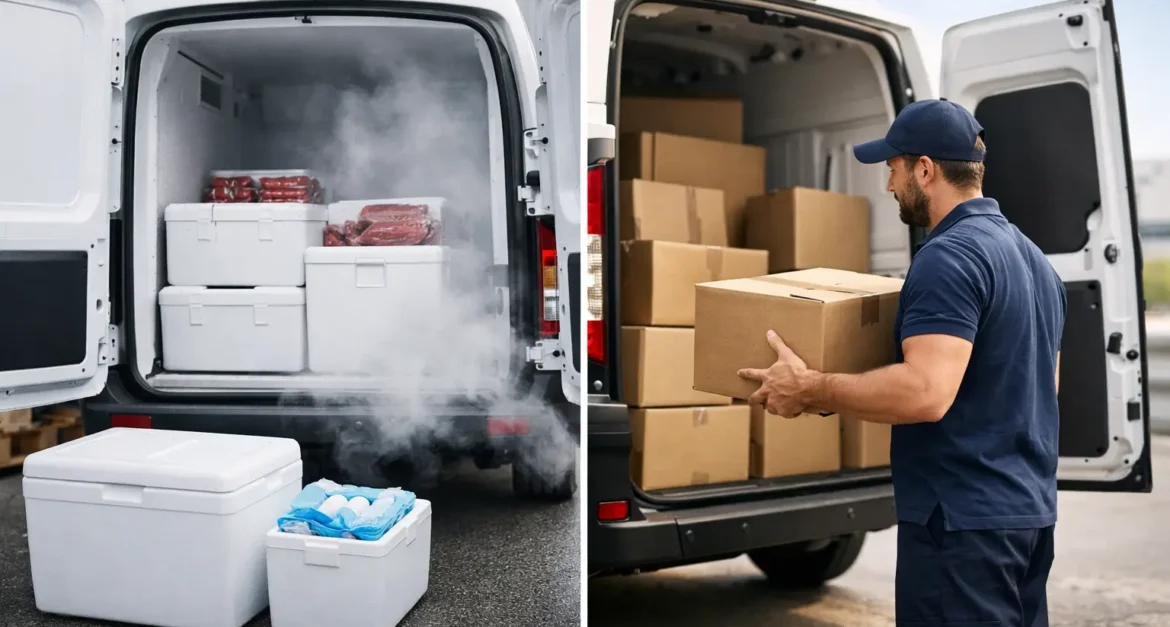
A delivery can arrive on time and still fail. If chilled food warms beyond its permitted range, a frozen product partially thaws, or a medicine loses thermal stability, the commercial impact begins long before the recipient signs for it. The choice between a refrigerated courier vs standard courier is therefore not simply a question of vehicle type or price. It is a decision about product integrity, evidence, risk and operational control.
For goods with defined temperature requirements, a standard courier may be the lower-cost option on paper, but it cannot provide the protection that a controlled cold-chain service is designed to deliver. Understanding the difference helps logistics teams select the right transport for every consignment, delivery window and customer commitment.
Refrigerated courier vs standard courier: the core difference
A standard courier transports goods in a conventional van or lorry, usually without active temperature control. The service is appropriate for ambient, non-perishable products that can tolerate normal changes in weather, traffic conditions and loading environments. Tracking may be available, but temperature management is not normally part of the operation.
A refrigerated courier uses a temperature-controlled vehicle to maintain an agreed setpoint or range throughout the journey. Depending on the requirement, this may support chilled, frozen, controlled ambient or multi-temperature loads. The vehicle, handling process and journey planning are built around protecting products that cannot safely be treated as general freight.
The distinction matters most when temperature is part of the product specification. For a food wholesaler, that could mean keeping chilled stock within its required range until handover. For a laboratory or pharmaceutical distributor, it may mean maintaining documented conditions that support quality procedures and regulatory obligations. In both cases, a delivery is only successful when the goods arrive in acceptable condition, with the required evidence available.
Temperature control is more than a cold vehicle
Refrigeration alone does not create a reliable cold chain. Control depends on the full operation: the correct vehicle being assigned, the compartment being prepared, goods being loaded efficiently, doors being kept closed where possible, and the route being managed against delivery deadlines.
A specialist refrigerated courier should work to the temperature requirement of the consignment, not a vague description such as “keep cool”. Chilled, frozen and controlled ambient products have different risks. A vehicle suitable for fresh produce may not be suitable for frozen food. A mixed load may require separated compartments or a multi-temperature solution so that each product travels within its own specified conditions.
Standard courier vehicles are exposed to the temperature of the day. A package may sit in a depot, travel alongside unrelated freight, be moved between vehicles, or wait during a multi-drop route. That can be acceptable for shelf-stable goods. It creates avoidable uncertainty for products where a short excursion could lead to spoilage, rejection or an investigation.
Visibility, traceability and proof of control
One of the most significant differences is what can be proven after delivery. Standard courier tracking can show where a vehicle or parcel was scanned, but it will not necessarily show the conditions the goods experienced between collection and delivery.
Refrigerated transport provides a stronger chain of accountability. GPS tracking supports journey visibility, while digital temperature monitoring can record the thermal conditions maintained during transit. This information gives operations teams a clear record to review if a customer, quality team or auditor raises a query.
Traceability is especially valuable when goods are high-value, regulated or time-critical. If a delivery is delayed by roadworks, a vehicle issue or a missed access slot, the transport provider must be able to assess the impact quickly and communicate clearly. Without temperature data, decisions are based on assumptions. With monitored evidence, teams can respond with greater confidence.
For pharmaceutical, medical and clinical goods, this is often fundamental rather than optional. Quality teams may require documented handling processes, temperature records and clear proof of delivery. Food businesses may also need this assurance when supplying retailers, hospitality groups or customers with strict intake procedures.
When a standard courier is the right choice
A standard courier should not be treated as an inferior service. It is the correct and efficient option for many consignments. Non-perishable packaged goods, dry stock, equipment, marketing materials and products with no controlled-temperature requirement can move safely through a conventional courier network.
It may also be suitable for goods that are described as ambient, provided they can tolerate expected environmental conditions and the journey is short enough to present minimal risk. The key is to confirm what “ambient” means for the product. In some sectors, it means ordinary room conditions. In others, it refers to a defined controlled range that still requires active monitoring and protection.
Cost is a genuine consideration. Standard courier services often have lower operating costs because they do not require refrigerated equipment, fuel for refrigeration units, specialist planning or temperature data management. Choosing standard transport for suitable goods can help control distribution spend without compromising quality.
The issue arises when cost becomes the only decision point. The saving from a lower-rate delivery can be quickly outweighed by one rejected pallet, one missed production run or one customer complaint linked to compromised stock.
When refrigerated transport is essential
Refrigerated transport is the appropriate choice when a product has a stated temperature range, a short shelf life, a freezing requirement, a safety risk or a customer requirement for cold-chain evidence. This includes fresh, chilled and frozen food, but the need extends well beyond food distribution.
Medical samples, pharmaceuticals, biotechnology products, specialist chemicals, cosmetics and temperature-sensitive components may all require controlled conditions. Event and hospitality operators may also need urgent refrigerated delivery when a late replenishment could disrupt service on the day.
Time pressure does not remove the need for control. In fact, urgent deliveries often increase risk because there is less margin for poor planning. A same-day refrigerated courier should combine a prompt response with the correct vehicle, a direct route where required, live visibility and clear delivery confirmation.
For recurring routes, dedicated day-rate vehicles can offer further control. They provide consistent capacity for businesses managing regular collections, retail replenishment, multi-drop schedules or fluctuating volumes. The operation can be planned around the customer’s delivery pattern rather than fitted into a general parcel network.
Assessing the real cost of each option
The price of a refrigerated courier is typically higher than standard transport because the service involves specialist vehicles, operational expertise and monitoring technology. That premium should be assessed against the total cost of failure, not only the transport invoice.
Consider the potential consequences of a temperature deviation: discarded stock, replacement production, failed deliveries, credit claims, wasted driver time, lost shelf life, damaged customer relationships and possible compliance exposure. For some products, a single incident can cost far more than a year of appropriate temperature-controlled transport.
The right question is not “Which courier is cheapest?” It is “Which service gives this consignment the right level of protection?” A high-value frozen load and a box of ambient consumables should not be planned in the same way. Matching the service to the risk helps avoid both over-specification and under-protection.
Questions to ask before booking
Before selecting a courier, establish the product’s required temperature range, maximum journey time, packaging capability and delivery conditions. Confirm whether the recipient has timed booking slots, security procedures, temperature checks or restrictions on vehicle access. These details influence the vehicle type and route plan.
You should also ask whether temperature monitoring is available, how records can be accessed, what happens if a deviation is identified, and whether the provider can support direct, multi-drop or dedicated transport. If goods are mixed, clarify whether chilled, frozen and ambient products need separate compartments.
For businesses operating under quality systems, check that the courier understands your handling requirements and can provide the level of traceability your internal procedures demand. A provider that asks detailed questions at the booking stage is helping to reduce risk before the vehicle leaves site.
Choosing control where it matters
MT Logistics Group supports UK businesses with refrigerated, frozen, ambient and multi-temperature transport where timing, product condition and traceability must remain under control. The aim is straightforward: collect the right goods in the right vehicle, maintain the required conditions and provide full visibility through to delivery.
A standard courier remains a practical option for goods that can safely travel without active thermal protection. Where temperature is part of the product promise, however, refrigerated transport is not an upgrade. It is the operational safeguard that protects the load, the customer relationship and the confidence behind every delivery.