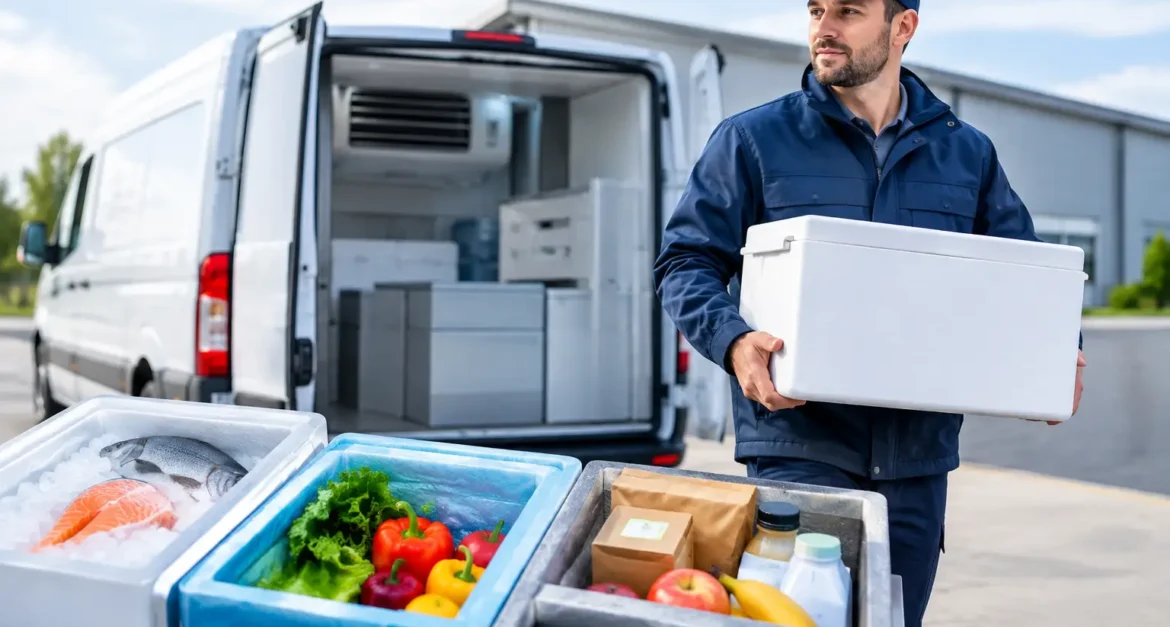
A mixed load can fail long before it reaches the customer. Frozen stock may be correctly set at -18°C, but a poorly positioned chilled pallet, repeated door openings or an unplanned delivery delay can still put the whole consignment at risk. This multitemperature delivery guide explains how UK businesses can plan, load and monitor mixed-temperature transport without compromising product quality, compliance or delivery performance.
What multi-temperature delivery means in practice
Multi-temperature delivery is the controlled transport of goods with different temperature requirements in one vehicle. A typical run may carry frozen products, chilled ingredients and ambient stock for several delivery points. The objective is not simply to make more space available. It is to keep each product within its specified temperature range throughout collection, transit and handover.
For food businesses, this can mean a wholesaler delivering frozen lines, dairy and fresh produce to hospitality sites on the same route. For pharmaceutical and healthcare operations, it may involve products with different approved storage conditions, where every movement and temperature record must stand up to audit.
The right solution depends on the load, route and risk profile. A vehicle with separate temperature-controlled compartments may be appropriate for regular mixed-load distribution. For some high-risk or highly time-sensitive consignments, separate vehicles or dedicated runs may provide stronger protection. Consolidation can reduce cost and vehicle movements, but it must never weaken temperature control or traceability.
Multi-temperature delivery guide: start with the product specification
The transport plan should begin with the product requirement, not the vehicle availability. Every item needs a clear agreed instruction covering its required storage range, permitted transit conditions, shelf-life sensitivity and any handling restrictions.
Set-point temperature and product temperature are not the same thing. The refrigeration unit may be operating to the correct set point while goods remain too warm after loading, or become exposed during a lengthy stop. Planning must account for product condition at collection, pull-down time where relevant, packaging performance, compartment capacity and the expected number of door openings.
For each consignment, confirm:
- the required temperature range and whether a validated range is mandatory
- whether chilled, frozen and ambient goods can travel together
- the maximum journey time and any fixed delivery window
- segregation needs, including allergens, odours, raw and ready-to-eat foods
- the evidence required at delivery, such as temperature logs, signatures and chain-of-custody records
This information should be agreed before collection. A last-minute instruction such as “keep it cold” is not enough for a controlled operation.
Ambient does not mean uncontrolled
Ambient goods are often treated as the easy part of a mixed load. That can be a mistake. Some products require protection from excessive heat, cold, moisture or direct sunlight, even when they do not need refrigeration. Cosmetics, ingredients, specialist components and certain medical products may have defined storage conditions that need to be considered in route planning and vehicle selection.
Ambient stock should also be protected from contact with chilled or frozen freight, condensation and loading damage. Clear compartment allocation and correct pallet placement help prevent avoidable compromise.
Select the vehicle around the route, not just the volume
A multi-temperature vehicle needs sufficient independently controlled capacity for the actual load profile. That includes the temperature zones, the pallet or cage configuration, the frequency of deliveries and the loading sequence. A vehicle that works for a single-drop delivery may not be suitable for a twelve-stop hospitality route with regular door openings.
Compartment layout matters. Frozen goods should not be loaded where they obstruct access to chilled products needed at the first stop. Goods for later drops should not force repeated handling of temperature-sensitive stock. Loading in reverse drop order, with clear labels and delivery documentation, reduces dwell time and handling errors.
Vehicle capability should be checked before dispatch. This includes the condition of seals and doors, operation of the refrigeration equipment, correct compartment set points and available capacity. Where the application requires it, operators should use equipment and procedures aligned with the relevant food hygiene, customer assurance and pharmaceutical GDP expectations.
For urgent work, a dedicated vehicle can be the safer choice. It gives the sender greater control over route, stops and handling, particularly where a consignment has a narrow delivery window or zero tolerance for delay.
Build a route that protects temperatures
The shortest route is not always the lowest-risk route. Congestion, restricted access, delivery curfews, driver waiting time and site unloading arrangements can all affect the length of time goods are exposed at the door.
A well-planned route groups deliveries by temperature zone and delivery window where possible. It also allows sensible contingency for traffic, site queues and failed access. For multidrop distribution, the delivery schedule should avoid opening the same compartment unnecessarily at several stops.
Communication is part of route control. Drivers need accurate site contacts, receiving hours, access instructions and any specific handover process before departure. Customers should know when to expect the delivery so staff are ready to unload promptly. A refrigerated vehicle can maintain its operating conditions, but it cannot remove the risk created by a pallet waiting on a warm loading bay.
Monitor the journey and act on exceptions
Real-time temperature monitoring and GPS tracking give transport teams the visibility to manage a journey rather than simply review it afterwards. The most useful systems show compartment temperatures, vehicle location and alerts for conditions that fall outside agreed parameters.
However, data only provides protection when someone is responsible for responding to it. A clear exception process should set out who receives an alert, how they assess the issue and when the customer or quality team must be informed. Actions may include checking door closure, reviewing refrigeration performance, redirecting the vehicle, arranging a replacement vehicle or placing affected goods into quarantine on arrival.
Temperature records should be retained in a format that can be matched to the consignment, vehicle and delivery time. For regulated pharmaceutical movements, monitoring equipment, calibration status and documented deviation handling may be central to compliance. For food distribution, records support due diligence, customer confidence and rapid investigation if a quality concern arises.
Do not hide a deviation
A small deviation does not automatically mean a product is unusable, and a reading within range does not automatically prove a product is safe. The outcome depends on the product specification, the duration of the event, the measured conditions and the customer’s quality procedure.
The correct response is controlled escalation, not assumption. Isolate the affected consignment where necessary, preserve the monitoring data and obtain a documented disposition decision from the authorised party. This protects the customer, the recipient and your own operation.
Make handover part of the cold chain
Delivery is not complete when the vehicle reaches the postcode. The final handover is a critical control point, particularly at busy restaurants, retail back doors, pharmacies and clinical sites.
Drivers should confirm the correct recipient, follow the agreed unloading process and capture proof of delivery. Where required, this should include temperature evidence, delivery condition notes and a record of any refusal or shortage. Damaged packaging, signs of thawing, incorrect stock rotation or unavailable receiving staff must be reported immediately.
The recipient also has a role. They should have suitable storage ready, inspect goods promptly and move them into the correct environment without delay. A controlled transport provider can protect the consignment in transit, but product integrity relies on disciplined handling at both ends.
Choose a partner with control, not just capacity
When comparing providers, look beyond whether they have a refrigerated lorry available. Ask how they manage separate temperature zones, what monitoring data they can provide, how they plan multidrop routes and what happens if an alert is raised. Request clarity on vehicle suitability, driver training, equipment maintenance and the process for reporting a deviation.
A dependable provider should be able to explain the controls in plain terms and adapt them to your operating model. Regular foodservice distribution, one-off frozen deliveries and validated medical consignments carry different risks. The right service is the one that matches those risks with the correct vehicle, monitoring and response plan.
For businesses moving mixed chilled, frozen and ambient loads across the UK, MT Logistics Group provides specialist multi-temperature transport with real-time visibility, traceable handling and responsive operational support. The most valuable delivery plan is the one your team can rely on when the route changes, the clock is tight and product condition cannot be left to chance.